
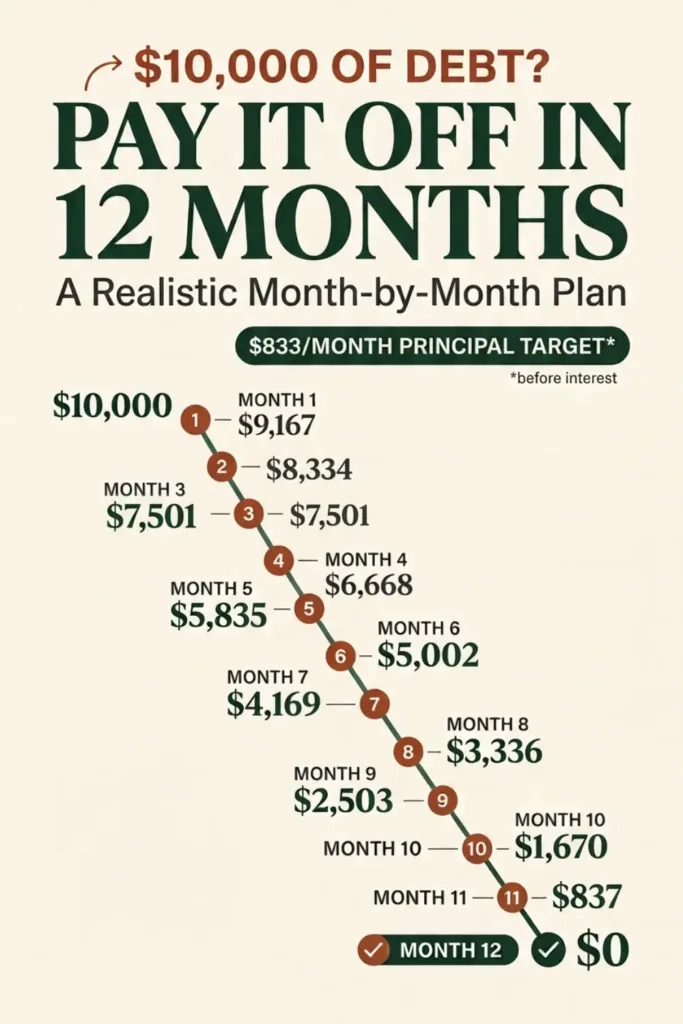

Paying off $10,000 in debt in 12 months requires more than sending extra money whenever you can. You need a monthly target, a repayment strategy, and enough room in your budget to make consistent progress.
At the simplest level, $10,000 divided across 12 months equals about $833 per month. However, interest can increase the actual amount required.
Therefore, this plan does not assume that exactly $833 will eliminate every $10,000 balance. Instead, it gives you a practical framework. You can adjust it for your interest rates, minimum payments, income, and other financial obligations.
The goal is straightforward: turn a large five-figure balance into 12 smaller monthly targets.
First, Calculate What $10,000 in 12 Months Really Means
Ignoring interest temporarily, the basic calculation is: 12$10,000=$833.33
Therefore, you need to reduce the principal by an average of approximately $833.33 per month.
You can also view the target differently:
| Time period | Principal-only target |
|---|---|
| 12 months | $833.33 per month |
| 52 weeks | $192.31 per week |
| 26 biweekly periods | $384.62 every two weeks |
| 24 semimonthly periods | $416.67 twice monthly |
These are principal-only planning figures. Interest and fees can change your actual required payments.
Consequently, the first step is not blindly setting an $833 payment. You need to examine each debt individually.
List:
- current balance;
- interest rate;
- minimum payment;
- due date;
- remaining term, when applicable;
- any relevant fees or promotional-rate expiration dates.
If your debt is spread across several accounts, this information determines where extra payments should go.
Your $833 Target Is Not Necessarily Your Extra Payment
This distinction matters.
Suppose your existing minimum payments total $350 monthly. You do not necessarily need to find another $833 in your budget.
Instead, your total debt payments may need to approach the amount required by your actual payoff calculation.
Part of that amount already exists in your current budget.
For example, suppose you determine that approximately $900 per month is needed after accounting for interest.
If you already pay $350 in minimums: $900−$350=$550
You need to find approximately $550 of additional monthly cash flow, rather than $900 of completely new money.
That makes the goal easier to evaluate.
However, this example is illustrative. Your required payment depends on your balances and rates.
Before Month 1: Build Your Debt Payoff System
A 12-month plan works better when you decide how payments will operate before aggressively cutting expenses.
Choose a repayment method
Two common approaches are the debt avalanche and debt snowball.
With the debt avalanche, extra money generally goes toward the debt carrying the highest interest rate first. After eliminating it, you redirect that payment toward the next-highest-rate debt.
With the debt snowball, you generally attack the smallest balance first. Once it disappears, its payment rolls into the next-smallest balance.
The avalanche focuses on interest cost. Meanwhile, the snowball emphasizes visible early wins.
Neither requires you to guess which approach fits your situation. Our detailed comparison of the debt snowball vs. debt avalanche explains the tradeoffs.
Build the payoff amount into your budget
Treat the target as a planned monthly expense.
If your budget is already stretched, start with essentials and minimum obligations. Then determine what can realistically be redirected toward debt.
Our guide to budgeting when money is tight can help you establish that baseline.
Most importantly, do not make an aggressive extra payment that leaves you unable to cover rent, food, utilities, transportation, insurance, or other essential expenses.
Keep a small financial buffer
Using every available dollar for debt can create another problem.
An unexpected car repair or medical bill may force you to borrow again.
If you have no emergency savings, consider maintaining a modest financial cushion while pursuing your debt goal. The guide on how to save a $1,000 emergency fund when money is tight provides one framework.
Now you can begin the 12-month process.
The 12-Month Plan to Pay Off $10,000 in Debt
The following roadmap uses $10,000 of starting principal and tracks principal reduction in roughly equal increments.
It deliberately does not invent an interest rate. Your actual payments should be adjusted for the terms of your debt.
Month 1 — Establish Your Baseline and Target $833
Target principal reduction: approximately $833
Approximate principal remaining: $9,167
Month 1 is about creating a system you can repeat.
Review at least the previous 30 days of spending. Separate your expenses into three groups:
- essential;
- contractual or required;
- discretionary.
Then identify how much money is already going toward debt.
Suppose your minimum payments total $375. If your actual monthly payoff requirement is around $900, your immediate cash-flow gap is approximately: $900−$375=$525
Now you have a specific problem to solve: find approximately $525 rather than vaguely trying to “spend less.”
Look first at expenses that can be changed quickly.
Possible examples include dining out, subscriptions, convenience purchases, entertainment, shopping, delivery fees, and other optional spending.
Do not begin by cutting essential expenses indiscriminately.
Month 2 — Find Recurring Money
Cumulative principal target: approximately $1,667
Approximate principal remaining: $8,333
Month 1 identifies the problem. Month 2 should make your solution repeatable.
A one-time $300 sale helps once. A recurring $100 monthly reduction can help for the remaining months.
Therefore, examine expenses such as:
- unused subscriptions;
- premium memberships;
- frequent takeout;
- unnecessary app charges;
- costly service plans;
- convenience spending;
- recurring purchases you barely notice.
For example, suppose you find:
| Change | Monthly amount redirected |
|---|---|
| Reduce restaurant/takeout spending | $150 |
| Cancel unused subscriptions | $55 |
| Reduce discretionary shopping | $125 |
| Lower entertainment spending | $70 |
| Reduce convenience purchases | $100 |
| Total | $500 |
That $500 becomes far more useful when consistently redirected.
For additional opportunities, review these steps to eliminate wasted expenses.
The objective is not extreme deprivation. Instead, you are temporarily assigning more of your existing income to a specific goal.
Month 3 — Automate Your Debt Payment
Cumulative principal target: approximately $2,500
Approximate principal remaining: $7,500
By Month 3, the plan should rely less on motivation.
Schedule your required minimum payments first. Then schedule your planned extra payment shortly after income arrives.
For example, someone paid twice monthly might divide an $840 monthly debt target into: 2$840=$420
They could plan approximately $420 from each paycheck.
Someone paid biweekly needs a different calculation because there are generally 26 biweekly pay periods across 52 weeks.
For a principal-only $10,000 target: 26$10,000≈$384.62
Using your pay cycle can make the goal feel smaller than one large end-of-month payment.
Month 4 — Add an Income Lever
Cumulative principal target: approximately $3,333
Approximate principal remaining: $6,667
Expense reductions have limits.
Eventually, increasing available income may be more practical than searching for another $10 to cut.
Month 4 is therefore a good point to investigate temporary additional income.
Possibilities vary widely by skills and circumstances. They might include freelance work, tutoring, weekend work, pet sitting, delivery work, selling unused belongings, or other legitimate paid services.
For example, an additional $125 per week for four weeks provides: $125×4=$500
That $500 could cover a large portion of the month’s additional debt-payment requirement.
Our guide to side hustles to pay off debt explores this strategy in more detail.
Remember to consider taxes, expenses, transportation, platform fees, and other costs associated with earning additional income.
Month 5 — Attack the Costliest Debt
Cumulative principal target: approximately $4,167
Approximate principal remaining: $5,833
At this point, review your repayment order.
If you selected the avalanche approach, extra payments should generally remain focused on the highest-rate balance.
If you selected the snowball, focus on your smallest outstanding balance.
Avoid spreading every extra dollar equally across several accounts unless there is a specific reason.
Concentrating extra payments allows one balance to disappear sooner. Then its former minimum payment becomes available for another debt.
This creates a repayment cascade.
Month 6 — Perform a Midyear Debt Audit
Cumulative principal target: approximately $5,000
Approximate principal remaining: $5,000
Month 6 is your major checkpoint.
Do not evaluate progress emotionally. Evaluate it mathematically.
Write down:
- starting debt;
- current debt;
- total principal reduction;
- current monthly payment;
- months remaining;
- new debt added;
- unexpected expenses;
- changes in income.
Suppose your balance has fallen from $10,000 to $5,700.
Your progress is: $10,000−$5,700=$4,300
You are $700 behind the simple $5,000 principal-reduction benchmark.
That does not mean the plan has failed.
Instead, calculate what the remaining target requires.
Ignoring future interest for this simple illustration: 6$5,700=$950
You would need approximately $950 of principal reduction monthly across the remaining six months.
Now you can decide whether that adjustment is realistic.
For a broader framework beyond this specific $10,000 target, see our 12-month debt payoff plan.
Month 7 — Redirect Every Debt Payment You Eliminate
Cumulative principal target: approximately $5,833
Approximate principal remaining: $4,167
Suppose you eliminate a smaller debt carrying a $90 monthly minimum.
Do not absorb that $90 into everyday spending.
Instead, roll it directly into your next targeted balance.
If you were paying $850 per month overall, you continue allocating approximately $850 rather than dropping to $760.
This is where earlier progress can begin accelerating the payoff process.
You are no longer finding every extra dollar from scratch. Some money is being released by balances you already eliminated.
Month 8 — Protect the Plan From Lifestyle Creep
Cumulative principal target: approximately $6,667
Approximate principal remaining: $3,333
Eight months is long enough for old habits to return.
A few restaurant meals become several. Shopping increases. Subscriptions creep back. Small convenience purchases become routine.
Therefore, compare Month 8 spending with Month 2.
Look particularly at categories you intentionally reduced.
If discretionary spending has increased by $200 monthly, that is potentially $800 over the final four months: $200×4=$800
That amount represents 8% of the original $10,000 principal.
This stage is particularly important if overspending contributed to the original balances.
If debt repeatedly disappears and returns, read our guide on how to escape the debt cycle.
Month 9 — Use Windfalls Strategically
Cumulative principal target: approximately $7,500
Approximate principal remaining: $2,500
Not every month has identical cash flow.
You may occasionally receive money outside your normal paycheck.
Examples could include a bonus, refund, gift, sale of unused belongings, or other irregular income.
Before spending it, decide whether some portion can advance your debt target.
Suppose you receive an unexpected $600 and decide that $400 can safely go toward debt.
That can reduce the pressure on your remaining monthly budget.
However, do not automatically send every windfall to creditors when you have overdue essentials or no financial buffer.
Debt repayment should operate inside a sustainable financial plan.
Month 10 — Check Whether Consolidation Would Actually Help
Cumulative principal target: approximately $8,333
Approximate principal remaining: $1,667
If you still have several balances, you may encounter offers promising to simplify them.
Debt consolidation can sometimes make payments easier to manage. However, consolidation does not automatically reduce the cost of debt.
Compare:
- interest rate;
- fees;
- repayment period;
- monthly payment;
- total expected repayment;
- whether the rate can change;
- whether old accounts could accumulate new balances.
A lower monthly payment can result simply from extending repayment over a longer period.
Therefore, evaluate total cost rather than the monthly payment alone.
Our guide to debt consolidation explains the approach and considerations in more detail.
Month 11 — Prepare for the Final Push
Cumulative principal target: approximately $9,167
Approximate principal remaining: $833
Now calculate the actual remaining balance rather than relying on the original schedule.
Your balance may be higher or lower than $833 because of interest and variations in earlier payments.
Suppose $1,150 remains.
Rather than abandoning the 12-month goal, break that amount into smaller targets.
For example, across two paychecks: 2$1,150=$575
You can then determine whether $575 per paycheck is feasible.
If not, do not skip essential bills merely to meet an arbitrary deadline.
The 12-month target is a planning tool. It should not force unsafe financial choices.
Month 12 — Pay the Remaining Balance and Redirect the Payment
Target principal remaining: $0
Month 12 is not finished when the last payment leaves your bank account.
First, confirm the actual payoff amount with the creditor when necessary. Pending interest or other amounts can sometimes affect the final figure.
Then decide what happens to the money you were using for debt.
Suppose you had been allocating $900 monthly.
If that entire $900 immediately returns to discretionary spending, you lose an important opportunity.
Instead, consider redirecting some of it toward:
- emergency savings;
- sinking funds;
- another remaining debt;
- upcoming irregular expenses;
- longer-term financial goals.
If cash-flow problems contributed to your original borrowing, strengthening your monthly system is particularly important. Our guide on how to stop living paycheck to paycheck can help with that transition.
Your $10,000 Debt Payoff Roadmap at a Glance
| Month | Cumulative principal-reduction target | Approx. principal remaining* | Main action |
|---|---|---|---|
| 1 | $833 | $9,167 | Build baseline |
| 2 | $1,667 | $8,333 | Cut recurring costs |
| 3 | $2,500 | $7,500 | Automate payments |
| 4 | $3,333 | $6,667 | Increase cash flow |
| 5 | $4,167 | $5,833 | Focus repayment |
| 6 | $5,000 | $5,000 | Midyear audit |
| 7 | $5,833 | $4,167 | Roll freed payments |
| 8 | $6,667 | $3,333 | Control spending creep |
| 9 | $7,500 | $2,500 | Use windfalls strategically |
| 10 | $8,333 | $1,667 | Review debt structure |
| 11 | $9,167 | $833 | Calculate final push |
| 12 | $10,000 | $0 | Finish and redirect payment |
*The table tracks the original $10,000 principal only. Actual balances depend on interest, fees, payment timing, and account terms.
Where Can You Find $833 a Month?
Seeing $833 as one number can make the target look intimidating.
Instead, build it from several sources.
Consider this hypothetical example:
| Source | Monthly amount |
|---|---|
| Existing minimum debt payments | $300 |
| Reduced dining and takeout | $140 |
| Reduced discretionary shopping | $100 |
| Canceled subscriptions | $45 |
| Temporary side income | $200 |
| Other spending reductions | $50 |
| Total allocated toward debt | $835 |
The lesson is important.
You do not necessarily need one dramatic $833 budget cut.
Your payment can come from several smaller sources.
Furthermore, the composition may change. One month could include additional income. Another might include a windfall. Another could rely primarily on spending reductions.
Consistency matters more than making every month identical.
What If You Cannot Afford $833 a Month?
Then $10,000 in 12 months may not currently be realistic.
That conclusion is useful information, not a reason to stop paying down debt.
Suppose you can sustainably allocate $600 monthly.
Ignoring interest: $600$10,000≈16.67
That means the principal alone represents roughly 17 months of $600 payments.
Interest can extend the actual period.
You could therefore choose among three broad options:
- extend your timeline;
- increase available income;
- reduce other spending where reasonably possible.
Often, a combination works better than an extreme version of any single strategy.
The worst approach is creating a payment target that repeatedly leaves you without enough money for essentials.
What If Your Income Changes During the 12 Months?
Do not assume each month must look identical.
If income falls, recalculate.
Use: New Monthly Principal Target=Months RemainingRemaining Principal
For example, suppose $6,400 remains with eight months left: 8$6,400=$800
Your new principal-reduction benchmark becomes approximately $800 monthly, before considering interest.
If your income increases, you can make the opposite adjustment.
The important point is to maintain a rolling payoff calculation rather than blindly following a schedule created months earlier.
Five Mistakes That Can Derail a 12-Month Debt Payoff Plan
1. Ignoring Interest
Dividing $10,000 by 12 is useful for planning principal reduction.
However, it does not calculate the exact payment required on interest-bearing debt.
Use your actual statements or creditor information to determine your payment requirements.
2. Sending Too Much Money Too Early
Aggressive repayment can backfire if it leaves nothing for essential expenses.
A sustainable $800 payment can be more useful than paying $1,200 one month and borrowing $400 the next.
3. Continuing to Add New Balances
Paying $900 toward old debt while adding $500 of new debt produces much less progress than the payment suggests.
Track net debt reduction, not merely payments made.
4. Treating Every Expense Cut as Permanent
A 12-month payoff sprint can include temporary reductions.
You do not necessarily need to permanently eliminate every discretionary category.
Decide what you are reducing, by how much, and for how long.
5. Forgetting to Review the Plan
Your starting calculation becomes less useful as circumstances change.
Review your balances at least monthly.
Then conduct a deeper review around Month 6.
Frequently Asked Questions
Can you really pay off $10,000 in debt in one year?
It can be mathematically possible, but affordability depends on your circumstances.
Ignoring interest, $10,000 requires an average principal reduction of approximately $833.33 monthly.
Interest and fees can increase the payment needed. Your income and essential expenses determine whether the target is realistic.
How much should I pay each month to pay off $10,000 in a year?
A simple principal-only calculation gives: $10,000÷12=$833.33
However, $833.33 is not a universal required payment.
Interest-bearing debts require additional amounts to cover interest. Use your actual balances and rates when calculating the precise payment.
Should I use the snowball or avalanche method?
The avalanche generally prioritizes higher-interest debt. The snowball generally prioritizes smaller balances.
The better fit depends partly on your financial situation and what helps you maintain the plan consistently.
Should I save money while paying off debt?
Keeping some accessible savings can help prevent an unexpected expense from immediately becoming new debt.
The appropriate balance depends on your circumstances, essential expenses, debt costs, income stability, and existing savings.
Should I consolidate $10,000 of debt?
Consolidation can be useful in some circumstances, but it is not automatically cheaper.
Compare rates, fees, repayment periods, total cost, and terms before deciding.
What happens if I miss my 12-month goal?
Recalculate rather than abandon the plan.
If $1,500 remains after Month 12, you have still reduced the original $10,000 balance substantially.
Create a new payoff target using the remaining balance and a realistic timeline.
Final Thoughts
Learning how to pay off $10,000 in debt in 12 months begins with one simple calculation: approximately $833 of principal per month.
However, the real strategy goes beyond division.
You need to understand your interest costs, protect essential expenses, choose a repayment method, create additional monthly cash flow, and review your progress repeatedly.
Most importantly, treat the 12-month deadline as a financial planning target rather than a test you must pass at any cost.
Build a payment you can sustain. Adjust when circumstances change. Then redirect the money freed by eliminated debt toward stronger financial foundations.