
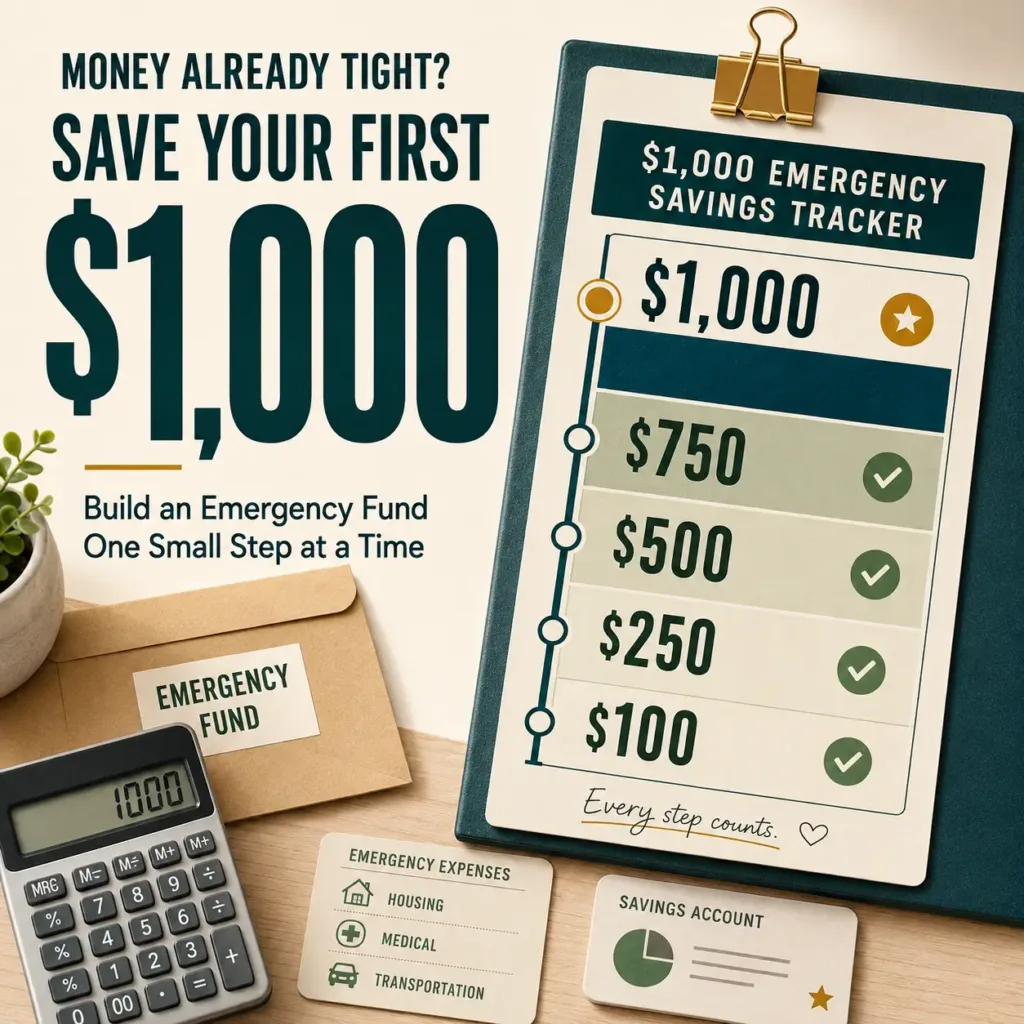

This article shows that Save $1000 for an Emergency Fund When Money Is Tight is achievable with a practical money management strategy, which we explain step by step.
Saving $1,000 for an emergency fund when money is tight can seem impossible at first. However, you do not need to find the entire $1,000 at once.
Instead, start with the amount your current budget can realistically support. Then, combine small recurring contributions with occasional extra money.
A $1,000 starter fund can give you a useful financial cushion for unexpected expenses. For example, it could help with an urgent car repair, medical bill, or necessary home repair.
The Consumer Financial Protection Bureau describes an emergency fund as money specifically reserved for unplanned expenses or financial emergencies. It also emphasizes that even small amounts can provide some financial security.
The objective, therefore, is not to make an already tight budget unbearable. It is to build your first $1,000 gradually while protecting essential expenses.
First, Make $1,000 a Concrete Savings Goal
A vague goal such as “save more money” is difficult to plan around.
A $1,000 target is different. You can divide it into smaller amounts and choose a timeline that fits your finances.
For example:
| Timeline | Approximate Amount to Save |
|---|---|
| 3 months | $333.33 per month |
| 5 months | $200 per month |
| 6 months | $166.67 per month |
| 10 months | $100 per month |
| 12 months | $83.33 per month |
These amounts are illustrative targets, not requirements.
Someone with $200 available each month could reach $1,000 in five months.
However, someone who can currently save only $50 monthly should not sacrifice groceries or essential bills to meet an arbitrary deadline.
At $50 per month:
$1,000 ÷ $50 = 20 months.
That may appear slow. Nevertheless, after six months, you would already have $300 that you did not previously have.
Your first milestone can also be smaller.
For instance:
$100 → $250 → $500 → $750 → $1,000
This makes progress easier to see.
If you need a broader explanation of why emergency savings matter, start with this guide to emergency funds and simple financial plans.
Step 1: Find Your Realistic Starting Amount
When money is tight, begin with your actual cash flow rather than an ideal savings percentage.
Review what comes in and what goes out.
Include:
- housing;
- utilities;
- groceries;
- transportation;
- insurance;
- minimum debt payments;
- childcare;
- healthcare;
- other essential commitments.
Then examine what remains.
Suppose your take-home income is $3,000 monthly and your current spending totals $2,950.
You have only $50 of apparent breathing room.
Trying to save $200 every month without changing anything would probably make the plan unsustainable.
Instead, begin with the $50. Then investigate whether additional room can be created.
If you do not know where your money is going, tracking your expenses should come before aggressive saving.
The CFPB similarly recommends looking at actual spending and comparing the resulting budget with take-home pay.
Step 2: Choose a Contribution You Can Repeat
Consistency matters more than choosing an impressive starting number.
Perhaps you can afford only $10 each week.
That still produces:
$10 × 52 = $520 per year.
At that pace, you would pass the halfway point during the first year.
Alternatively, suppose you can save $25 every two weeks.
With 26 bi-weekly contributions:
$25 × 26 = $650 per year.
Then, you would need another $350 to reach the $1,000 goal.
The contribution can also change over time.
For example, you might begin at $15 per paycheck. Later, you could increase it to $25 after eliminating a recurring expense.
This flexible approach works better than waiting until you can afford a large contribution.
Step 3: Look for Money Already Leaving Your Budget
When income is limited, saving more often requires redirecting existing spending.
However, start with expenses that provide relatively little value.
Review areas such as:
- unused subscriptions;
- frequent convenience purchases;
- delivery fees;
- impulse purchases;
- unnecessary account or service fees;
- expensive plans you rarely use;
- habitual small purchases.
Suppose you identify:
| Change | Monthly Amount Redirected |
|---|---|
| Cancel one unused subscription | $15 |
| Reduce takeout | $30 |
| Cut convenience purchases | $20 |
| Lower another optional expense | $15 |
| Total | $80 |
Redirecting $80 monthly creates $960 over 12 months.
You would then need only another $40 to reach $1,000.
These numbers are hypothetical. Your opportunities will differ.
The purpose is to identify expenses you can comfortably change, rather than cutting necessities.
For additional ideas, review these ways to cut unnecessary expenses and these steps for eliminating wasted expenses.
Step 4: Separate the Emergency Money
Saving becomes harder when emergency money remains mixed with everyday spending.
A dedicated savings account creates a clear boundary.
For example, suppose your checking account contains $1,400.
If $350 of that amount represents emergency savings, it is easy to mentally treat the entire $1,400 as spendable.
Keeping the $350 separately makes its purpose clearer.
The CFPB recommends keeping emergency savings somewhere safe, accessible, and less tempting to spend on non-emergencies.
Therefore, accessibility matters.
Emergency money should not be so difficult to reach that you cannot use it when a genuine emergency occurs.
A savings account may be appropriate. Depending on your options, you can also compare a high-yield savings account with a conventional savings account.
However, do not let the search for the perfect account delay your first contribution.
The saving habit comes first.
Step 5: Save Windfalls Instead of Depending Entirely on Monthly Cuts
Your $1,000 does not have to come exclusively from ordinary monthly income.
Occasional extra money can accelerate the plan considerably.
Possible examples include:
- a work bonus;
- cash gifts;
- rebates;
- refunds;
- proceeds from selling unused belongings;
- temporary additional income;
- reimbursements.
Suppose you can save $60 each month.
After ten months:
$60 × 10 = $600.
Now suppose you also direct a $150 windfall and $250 from selling unused items into the fund.
$600 + $150 + $250 = $1,000.
You reach the same goal without forcing your monthly budget to produce the entire amount.
The CFPB specifically identifies one-time opportunities and consistent contributions as possible emergency-saving strategies.
The important point is to decide what happens to extra money before it disappears into ordinary spending.
Step 6: Use Small Milestones
A distant $1,000 target can feel discouraging.
Therefore, divide the goal.
Milestone 1 — $100
Your first $100 proves that the plan has started.
Milestone 2 — $250
At this stage, you have a modest cushion for some smaller unexpected costs.
Milestone 3 — $500
You are halfway to the target.
Milestone 4 — $750
Only $250 remains.
Milestone 5 — $1,000
You have completed the starter goal.
Tracking these milestones can make progress more visible.
The CFPB also recommends setting a specific goal and regularly monitoring savings progress.
If structured targets motivate you, a bi-weekly savings challenge can provide additional ideas. However, adjust any challenge amounts to your actual budget.
Step 7: Automate a Small Amount When Possible
Automation can remove a repeated decision from the saving process.
Suppose you receive two paychecks each month and automatically transfer $25 after each paycheck.
That creates approximately:
$25 × 2 = $50 per month.
After one year:
$50 × 12 = $600.
Then, occasional extra contributions could close the remaining $400.
Alternatively, a person paid every two weeks could save $20 from each of 26 paychecks:
$20 × 26 = $520.
The FDIC gives this same $20-per-biweekly-paycheck example and notes that it totals $520 over a year before interest.
However, automation should not create overdrafts.
If your checking balance regularly becomes very low before payday, choose a smaller amount or transfer manually until cash flow becomes more predictable.
Step 8: Make Saving Easier by Changing the Habit Behind the Spending
Not every savings problem is mathematical.
Sometimes the available money disappears through repeated spending decisions.
For example, a person may intend to transfer $30 into savings. Then an impulse purchase absorbs that $30.
The budget technically contained enough money. The difficulty was protecting it.
Therefore, identify your common spending triggers.
Ask yourself:
- Do I shop when bored?
- Do I spend more immediately after payday?
- Do I use shopping as a reward?
- Do I buy because something is discounted?
- Do I regularly underestimate small purchases?
Once you identify the pattern, create friction.
For example, wait 24 hours before nonessential purchases. Remove stored card details from shopping websites. Unsubscribe from promotional messages.
The goal is not to eliminate every enjoyable purchase.
Instead, protect the money you intentionally assigned to your emergency fund.
Our guide to the psychology of saving explores this behavioral side in more detail.
A Realistic $1,000 Emergency Fund Example
Consider a hypothetical household that cannot comfortably save $200 every month.
Instead, it creates this plan:
| Source | Amount |
|---|---|
| $50 per month for 12 months | $600 |
| Reduced subscriptions | $120 |
| Two small cash windfalls | $130 |
| Sale of unused items | $150 |
| Total | $1,000 |
This plan requires only $50 of regular monthly saving.
The other $400 comes from redirected expenses and occasional money.
That distinction matters when money is tight.
Instead of asking:
“How can I suddenly find $1,000?”
ask:
“What combination of small contributions can eventually equal $1,000?”
That question usually produces more realistic options.
What If You Can Save Only $5 or $10?
Save the smaller amount.
A small emergency fund is still larger than no emergency fund.
The CFPB specifically notes that even small amounts can provide some financial security when saving capacity is limited.
Suppose you save only $10 per week.
After 10 weeks, you have $100.
After 25 weeks, you have $250.
After 50 weeks, you have $500.
Then, additional income or expense reductions can shorten the remaining timeline.
You can also increase your contribution later.
A $10 starting contribution is not a permanent commitment. It is simply your current starting point.
Do Not Sacrifice Essential Bills to Reach $1,000 Faster
An emergency fund is designed to strengthen your finances.
Therefore, building one should not create another immediate financial emergency.
Do not skip necessities simply to reach the target faster.
Protect expenses such as:
- housing;
- essential utilities;
- basic food;
- essential transportation;
- necessary healthcare;
- required insurance;
- minimum contractual debt obligations.
If little or nothing remains after essentials, the immediate priority may be stabilizing cash flow.
In that situation, focus first on tracking expenses, reviewing optional spending, and identifying available assistance or income opportunities.
Then begin your emergency fund when even a small sustainable contribution becomes possible.
Define What Counts as an Emergency
Once your balance grows, decide what the money is for.
A useful emergency is generally an expense that is:
unexpected, necessary, and urgent.
Examples may include:
- an essential car repair;
- an urgent medical cost;
- a necessary home repair;
- temporary income loss;
- emergency travel.
A sale on clothing is not an emergency.
A planned annual insurance bill is also not truly unexpected. That expense belongs in your regular budget or a separate sinking fund.
Defining the rules protects your $1,000 from gradually becoming another spending account.
However, do not become afraid to use the fund for a genuine emergency. That is its purpose.
After using it, create a plan to rebuild the balance. The CFPB likewise recommends establishing guidelines for emergency use and rebuilding the fund after it is spent.
What Comes After Your First $1,000?
Treat $1,000 as a starter milestone rather than a universal final emergency-fund amount.
Your longer-term target depends on your circumstances.
Consider factors such as:
- essential monthly expenses;
- income stability;
- household size;
- insurance coverage;
- health needs;
- transportation reliability;
- dependents;
- availability of other financial resources.
Someone with irregular income may want a different cushion than someone with two stable household incomes.
Therefore, once you reach $1,000, calculate a larger target appropriate to your situation.
You do not need to reach that larger target immediately.
Continue using the same process:
set a target → divide it into manageable contributions → automate when practical → use extra money → track progress.
Frequently Asked Questions
How long should it take to save a $1,000 emergency fund?
There is no required timeframe.
At $50 monthly, the target takes 20 months. At $100 monthly, it takes 10 months. At $200 monthly, it takes five months.
Choose a timeline that does not undermine essential expenses.
Is $1,000 enough for an emergency fund?
It can be a useful starter target, but it is not necessarily a complete emergency fund.
The appropriate longer-term amount depends on your expenses, income stability, household needs, and potential financial risks.
Where should I keep my $1,000 emergency fund?
Consider a separate, accessible savings account. The money should generally be safe and available when a genuine emergency occurs.
Should I save even if I can afford only a few dollars?
Yes, provided saving that amount does not interfere with essential expenses.
Small contributions accumulate. More importantly, they establish the system you can expand when your finances improve.
What if I have to spend the emergency fund before reaching $1,000?
Use it when you face an expense that meets your emergency criteria.
Then resume saving when possible. Using emergency savings for a genuine emergency does not make the plan unsuccessful.
Final Thoughts
Save $1000 for an emergency fund when money is tight can be primarily a problem of breaking a large target into manageable pieces.
You might reach $1,000 through $100 monthly contributions. Alternatively, your plan could combine $25 paychecks, reduced expenses, occasional windfalls, and extra income.
The exact route matters less than whether it fits your real finances.
Start with what you can safely afford. Separate the money. Track each milestone. Then increase contributions when circumstances allow.
Your first $100 matters. So does $250. Eventually, those smaller amounts can become the $1,000 cushion you were trying to build.