
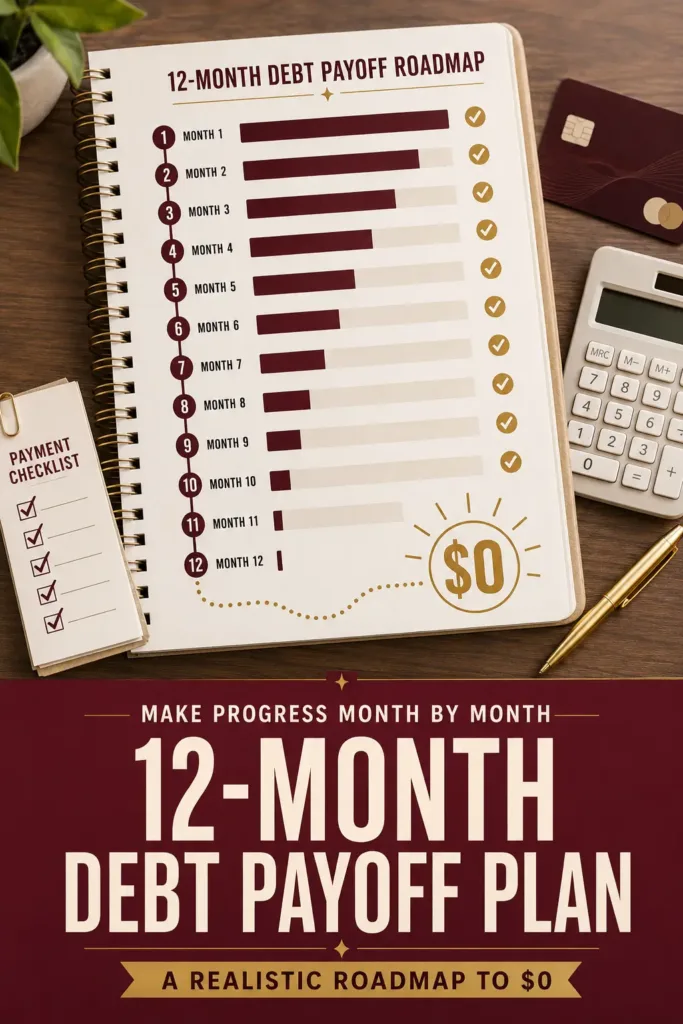

A 12-month debt payoff plan can turn a vague goal into a series of manageable monthly decisions. However, paying off debt within one year requires more than choosing an ambitious target.
First, you need to know exactly what you owe. Next, you need to calculate what your budget can realistically support. Then, you need a repayment strategy that accounts for minimum payments, interest charges, unexpected expenses, and changing monthly cash flow.
For some people, becoming completely debt-free in 12 months will be realistic. For others, one year may represent the first major stage of a longer debt-free journey.
Either outcome can represent meaningful progress.
This guide shows how to build a practical 12-month debt payoff timeline, measure your progress, and adjust the plan without treating every setback as failure.
Start With the Numbers Before Setting the Deadline
A one-year payoff goal should begin with your current debt balances, not with an arbitrary monthly payment.
Create a simple list containing:
- each debt;
- current balance;
- interest rate;
- minimum monthly payment;
- payment due date;
- any relevant fees or promotional terms.
Then calculate your total outstanding balance.
For example, suppose your debts look like this:
| Debt | Balance | Minimum Payment |
|---|---|---|
| Credit card A | $3,200 | $100 |
| Credit card B | $1,800 | $65 |
| Personal loan | $4,000 | $180 |
| Medical balance | $1,000 | $50 |
| Total | $10,000 | $395 |
These figures are hypothetical.
Your first important number is the total balance: $10,000.
However, simply dividing $10,000 by 12 does not give the exact payment needed. Interest and possible fees may increase the total amount you must repay.
Still, the division provides a useful starting point:
$10,000 ÷ 12 = approximately $833.33 per month
Therefore, you would need to reduce principal by an average of about $833 each month to eliminate $10,000 within one year.
Your actual required payments could be higher because interest continues to accrue.
That distinction matters.
Determine Whether 12 Months Is Realistic
Next, compare your debt target with the money your budget can actually provide.
Suppose your household can currently devote $550 per month toward debt.
If the principal-only target is approximately $833 per month, there is a gap:
$833 – $550 = $283 per month
You now have a specific problem to solve.
You could potentially close that gap through some combination of:
- reducing discretionary expenses;
- redirecting money from completed savings goals;
- using additional income;
- selling unused items;
- allocating bonuses or refunds;
- decreasing another budget category temporarily;
- choosing a longer repayment timeline.
However, essential costs should remain protected.
Rent, food, utilities, transportation, necessary insurance, medicine, and other essential needs should not be sacrificed merely to satisfy an artificial payoff date.
If your available payment is substantially below the amount required, extending the timeline may be more realistic.
A 15-month or 18-month debt payoff plan that you can maintain is often more useful than an aggressive 12-month target you abandon after several weeks.
Choose Your Debt Payoff Strategy
Once you know how much you can pay, decide how extra payments will be directed.
Two common approaches are the debt avalanche and debt snowball methods.
Debt Avalanche
With the debt avalanche, you generally:
- make required minimum payments on all debts;
- direct additional money toward the debt with the highest interest rate;
- eliminate that debt;
- redirect its former payment toward the next highest-rate debt.
The main objective is reducing interest cost.
This strategy can be mathematically efficient when debts carry different interest rates.
Debt Snowball
With the debt snowball, you generally:
- make minimum payments on all debts;
- direct additional money toward the smallest balance;
- eliminate it;
- roll its payment into the next-smallest balance.
The main advantage is psychological momentum.
Clearing a small balance early can make progress more visible.
Which Approach Should You Use?
Neither strategy automatically fits everyone.
The avalanche may appeal to readers focused on minimizing interest.
The snowball may appeal to readers who benefit from frequent milestones.
You can also create a customized approach when one particular debt has an unusual deadline, promotional period, or other important condition.
The essential rule is consistency.
Choose a priority system before the month begins. Then avoid changing strategies every few weeks without a clear reason.
Your Realistic 12-Month Debt Payoff Timeline
A successful debt-free journey does not require every month to look identical.
Instead, give each month a specific purpose.
Month 1 — Build the Complete Debt Picture
The first month is about organization.
List every balance, rate, minimum payment, and due date.
Then review recent spending.
Your goals are to determine:
- how much debt exists;
- how much you currently pay;
- how much additional money may be available;
- which repayment method you will use.
Also choose a fixed monthly debt-payment target.
For example, you might decide that your budget can support $850 per month.
That becomes your initial working number.
Do not choose $850 merely because it produces an attractive timeline. Your normal income and expenses must support it.
Month 1 Action List
- Record all debts.
- Calculate total balances.
- Add minimum payments.
- Choose your repayment priority.
- Set your target monthly payment.
- Create a simple progress tracker.
At the end of Month 1, you should know exactly what the next 11 months require.
Month 2 — Find Your First Payment Increase
Month 2 focuses on cash flow.
Review recurring and discretionary expenses.
Possible areas include:
- unused subscriptions;
- frequent convenience purchases;
- entertainment spending;
- impulse shopping;
- restaurant spending;
- optional upgrades;
- recurring services that provide little value.
Suppose you identify $125 per month that can realistically be redirected.
Instead of thinking, “I need to pay off $10,000,” your immediate decision becomes:
“I will redirect this $125 toward my priority debt.”
That is more actionable.
Keep the change sustainable.
Eliminating every enjoyable expense for an entire year can make the plan unnecessarily difficult.
Month 3 — Stabilize the Routine
By the third month, debt payments should start becoming a routine rather than a special event.
Schedule payments around your income.
For example, someone paid twice monthly might divide an $850 target into:
$850 ÷ 2 = $425 per paycheck
That can feel easier to manage than finding $850 at the end of the month.
If income varies, use a different system.
You might establish:
- a minimum debt payment during low-income months;
- a target payment during normal months;
- an additional payment when income exceeds expectations.
Your plan should accommodate reality rather than assuming every month will be identical.
Month 4 — Complete the First Major Review
Three full months of repayments now provide useful information.
Compare:
Planned payments vs. actual payments
Suppose you planned:
$850 × 3 = $2,550
However, you actually paid $2,300.
The difference is:
$2,550 – $2,300 = $250
Do not automatically treat this as failure.
Instead, identify why the difference occurred.
Perhaps:
- an essential expense increased;
- income was lower;
- the original target was too aggressive;
- spending exceeded the budget;
- an unexpected bill appeared.
Then adjust the remaining months.
A debt plan becomes stronger when it responds to actual numbers.
Month 5 — Redirect a Finished Payment
One powerful moment in a debt payoff plan occurs when a balance disappears.
Suppose you were paying $100 each month toward a small debt.
Once that balance is eliminated, avoid absorbing the $100 back into ordinary spending unless necessary.
Instead, redirect it toward your next debt.
For example:
Previous target payment: $850
Freed payment: $100
Potential new payment: $950
This is how repayment momentum can increase without requiring another lifestyle cut.
The exact timing will depend on your balances and strategy.
Month 6 — Conduct the Halfway Check
Month 6 is a major review point.
Ask five questions:
- What was my starting balance?
- What is my current balance?
- How much have I actually paid?
- Is my original 12-month deadline still realistic?
- What needs to change for the second half?
Suppose you started at $10,000.
Your current balance is $5,700.
Ignoring the complexity of interest for this simplified comparison, you have reduced the balance by:
$10,000 – $5,700 = $4,300
You would still need to eliminate $5,700 during the final six months.
That is approximately:
$5,700 ÷ 6 = $950 per month
Again, actual required payments depend on interest and account terms.
Now you can make an informed decision.
You may increase payments, use additional income, or extend the deadline.
The midpoint is for recalibration, not self-criticism.
Month 7 — Strengthen Your Financial Buffer
Aggressive debt repayment can become fragile if you have no money available for unexpected expenses.
For example, a repair or medical bill may force you to borrow again.
Therefore, avoid draining every accessible dollar merely to produce faster debt progress.
Your appropriate cash buffer depends on your circumstances.
Consider factors such as:
- income stability;
- dependents;
- health needs;
- transportation needs;
- housing responsibilities;
- available insurance;
- access to other resources.
The goal is to reduce debt without repeatedly creating new debt.
Month 8 — Look for a Temporary Income Boost
By Month 8, cutting expenses further may become difficult.
At that point, additional income may have more potential than additional cuts.
Possible examples include:
- overtime when available;
- freelance work that fits your schedule;
- selling unused belongings;
- seasonal employment;
- occasional contract work;
- directing a bonus toward debt.
Suppose you generate an additional $400 during Month 8.
If your normal payment is $850, your total payment could potentially become:
$850 + $400 = $1,250
A few irregular extra payments can meaningfully affect a 12-month timeline.
However, do not include uncertain income in your baseline plan.
Treat it as an additional payment when it actually arrives.
Month 9 — Protect Yourself From Debt Fatigue
Nine months is long enough for motivation to change.
Therefore, rely on systems rather than enthusiasm.
Keep the plan visible.
Track:
- starting balance;
- current balance;
- amount eliminated;
- number of debts closed;
- remaining months.
For example:
Starting balance: $10,000
Current balance: $3,400
Balance reduction: $6,600
Percentage of starting balance reduced:
$6,600 ÷ $10,000 × 100 = 66%
This does not mean your exact payoff progress is 66% after accounting for every possible interest charge. Rather, it shows how much the listed balance has declined relative to the starting point in this simplified example.
Visible progress can make the remaining work feel more concrete.
Month 10 — Review Every Remaining Debt
You are now entering the final quarter.
Update every account.
Do not rely on figures from several months earlier.
Record:
- current balance;
- current minimum;
- current interest rate;
- payoff information when available;
- remaining planned payments.
Then calculate how much remains before your target date.
Suppose the remaining balance is $2,500 with three months left.
A simple principal-only baseline is:
$2,500 ÷ 3 = approximately $833.33 per month
If your regular payment target is already above this figure, you may be close to schedule.
However, verify actual account balances because interest and timing can affect the amount needed.
Month 11 — Prepare the Final Push Without Emptying Your Budget
Near the finish line, it can be tempting to send every available dollar toward debt.
That is not always sensible.
First, protect essential bills.
Then consider whether additional discretionary money can reasonably be redirected.
A one-time payment might come from:
- accumulated extra income;
- a planned spending reduction;
- money left in a discretionary category;
- an unexpected but nonessential windfall.
Avoid assuming that money intended for taxes, essential repairs, medical needs, or other obligations is available for debt repayment.
The objective is finishing strongly without immediately creating another financial problem.
Month 12 — Verify the Payoff and Plan What Happens Next
Month 12 is not simply about making one final payment.
First, verify the exact amount required with the lender or account provider when necessary.
Your displayed balance and final payoff amount may not always be identical.
Then confirm that payments have been processed properly.
Once a debt is eliminated, decide what happens to the money previously used for repayments.
For example, suppose your monthly debt payment had reached $950.
After payoff, that $950 could potentially support goals such as:
- strengthening emergency savings;
- funding planned future expenses;
- catching up on other financial goals;
- increasing long-term savings;
- investing when appropriate to your circumstances.
Avoid automatically allowing the entire amount to disappear into lifestyle spending, see our guide about mastering Expense Tracking: A Guide to Financial Success — useful for tracking biweekly deposits.
Your debt payoff can create permanent monthly cash flow.
That is one of the most valuable outcomes of the process.
A Sample 12-Month Debt Payoff Tracker
The following table is illustrative.
It does not account for a specific interest rate.
| Month | Primary Goal | Example Target |
|---|---|---|
| 1 | Organize debts and choose strategy | $850 |
| 2 | Redirect unnecessary spending | $850 |
| 3 | Establish payment routine | $850 |
| 4 | Review progress | $850 |
| 5 | Roll freed payments forward | $900 |
| 6 | Complete halfway review | $900 |
| 7 | Protect financial buffer | $900 |
| 8 | Add optional extra income | $1,200 |
| 9 | Maintain momentum | $900 |
| 10 | Recalculate remaining balances | $900 |
| 11 | Prepare final payments | $950 |
| 12 | Verify and complete payoff | Remaining balance |
These figures should not be copied into your budget automatically.
Instead, build your own schedule from actual balances, interest rates, income, minimum payments, and essential expenses.
What If You Cannot Become Debt-Free in 12 Months?
Then change the timeline.
The one-year target is a planning tool. It is not a financial rule.
Suppose your debt requires approximately $900 per month to meet a 12-month target, but your sustainable budget provides only $600.
Trying to force the missing $300 could create unnecessary pressure.
Instead, calculate what your $600 payment can accomplish.
You may discover that your realistic timeline is 17 months, 20 months, or longer.
That does not make the plan unsuccessful.
The more useful question is:
Are your balances moving consistently in the right direction without destabilizing essential parts of your finances?
If yes, your debt-free journey is working.
Five Problems That Can Disrupt a 12-Month Payoff Plan
1. Setting the Payment Before Building the Budget
An attractive payoff target does not automatically fit your cash flow.
Start with income and essential expenses.
Then determine what is available for debt.
2. Ignoring Interest
Dividing the current balance by 12 gives only a basic planning benchmark.
Interest may increase the total amount required.
Use current account information when calculating an exact payoff schedule.
3. Sending Every Spare Dollar to Debt
A plan with no buffer can collapse after one unexpected expense.
Balance faster repayment with reasonable financial resilience.
4. Counting Uncertain Income Before Receiving It
Do not build your normal repayment schedule around a bonus, overtime, or freelance income that may never arrive.
Use uncertain money as an additional payment after receiving it.
5. Increasing Spending After One Debt Disappears
When one balance reaches zero, its former payment creates an opportunity.
Redirecting that payment to another balance can accelerate the plan.
How to Know Whether Your Debt-Free Journey Is Working
Do not evaluate progress only by asking whether you are perfectly on schedule.
Review several measures.
Your Total Balance Is Declining
This is the clearest long-term indicator.
Record your total debt at least monthly.
You Are Avoiding New Unplanned Debt
Paying down $700 while adding another $600 of debt produces limited progress.
Therefore, watch both repayment and new borrowing.
Your Payments Are Becoming Easier to Manage
A good system should become more organized over time.
Due dates, minimum payments, and extra payments should become predictable.
Your Monthly Cash Flow Improves as Balances Disappear
Eliminating one required payment can create more room for the next debt.
Eventually, eliminating all targeted debt may free substantial monthly cash flow.
Frequently Asked Questions
Can you really pay off debt in 12 months?
It depends on your total balance, interest rates, minimum payments, income, expenses, and available monthly cash flow.
Some balances can realistically be eliminated within one year.
Others require more time.
Calculate your own numbers before committing to the deadline.
How much should I pay every month?
Start by estimating:
Total debt balance ÷ 12
This gives a simple principal-only monthly baseline.
Then account for interest, fees, and minimum-payment requirements.
Your exact required amount may therefore be higher.
Should I use the debt snowball or debt avalanche?
The debt avalanche generally prioritizes the highest interest rate.
The debt snowball generally prioritizes the smallest balance.
Choose the method you are most likely to follow consistently while understanding the cost differences involved.
Should I stop saving while paying off debt?
Not automatically.
Your appropriate balance between saving and debt repayment depends on your circumstances.
Maintaining some financial cushion may reduce the risk of borrowing again when an unexpected expense occurs.
What happens if I miss my monthly payoff target?
Recalculate.
Identify whether the shortfall came from spending, lower income, an unexpected essential expense, or an unrealistic original target.
Then redistribute the remaining amount across future months when affordable.
Extending the deadline is also an option.
Final Thoughts
A 12-month debt payoff plan works best as a structured roadmap rather than a rigid financial deadline.
Month 1 establishes your starting point. The middle months build consistency and repayment momentum. The final months focus on recalculating balances and directing available cash toward the remaining debt.
However, the most important result is not finishing on an exact calendar date.
The stronger result is building a repayment system that reduces balances steadily without sacrificing essential expenses or repeatedly creating new debt.
If 12 months fits your numbers, use the timeline aggressively but realistically.
If it does not, extend the journey.
A sustainable debt payoff plan remains valuable even when the finish line moves.