
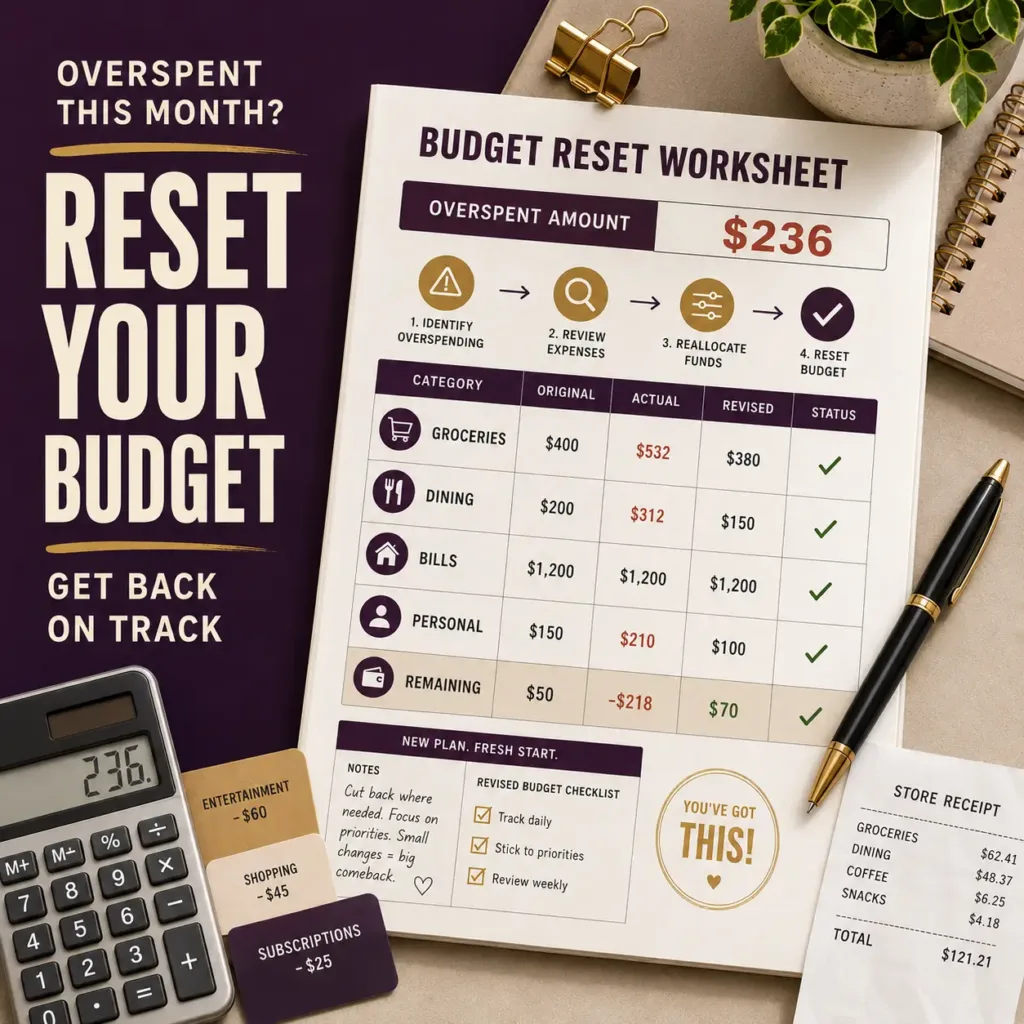

Overspending does not automatically mean your entire budget has failed. Often, it means the original plan needs an adjustment.
Learning how to reset your budget after overspending starts with finding the actual shortfall. Then, you can decide what must change before the month ends.
The goal is not to punish yourself for spending too much. Instead, the goal is to restore control over the money that remains.
A good budget reset usually involves five actions. First, identify what happened. Next, calculate the gap. Then, protect essential expenses. After that, reduce flexible spending. Finally, adjust the next few weeks realistically.
Here is how to do it.
Start by Finding Out Exactly How Much You Overspent
Avoid making immediate cuts before you know the size of the problem.
Instead, compare your planned spending with your actual spending.
Suppose you planned these amounts:
| Category | Planned | Actual | Difference |
|---|---|---|---|
| Groceries | $500 | $610 | +$110 |
| Dining out | $120 | $205 | +$85 |
| Entertainment | $80 | $125 | +$45 |
| Transportation | $200 | $185 | -$15 |
| Personal spending | $100 | $135 | +$35 |
Your net overspending would be:
$110 + $85 + $45 – $15 + $35 = $260
Therefore, the budget problem is not simply, “I spent too much.”
The more useful statement is:
I need to absorb a $260 budget shortfall.
That number gives you something concrete to solve.
If you are unsure where your money went, begin with expense tracking. A complete spending record makes the reset much more accurate.
Review bank transactions, credit-card charges, cash purchases, and automatic payments.
However, do not review transactions only to assign blame.
Instead, classify them.
Ask whether each purchase was essential, planned but underestimated, optional, unexpected, or avoidable.
That distinction will help you choose the right correction.
Identify Why the Overspending Happened
Not every budget overrun has the same cause.
Therefore, the solution should depend on what actually happened.
Your original budget may have been unrealistic
You may have budgeted $350 for groceries even though your household normally spends closer to $500.
In that case, the problem is not necessarily poor discipline.
The category may simply have been underfunded.
A good reset should correct unrealistic assumptions instead of repeatedly demanding an impossible spending target.
If your original plan needs rebuilding, review the basics of creating a workable budget.
An unexpected expense may have appeared
A car repair, medical bill, school expense, or urgent household purchase can disrupt even a careful plan.
In that situation, your budget needs reallocation rather than punishment.
For example, imagine you had $200 reserved for dining, entertainment, and personal spending.
Then, an unexpected $175 repair appears.
You could temporarily redirect part of those flexible categories toward the repair.
Discretionary spending may have gradually increased
Small purchases can accumulate quickly.
A few takeout meals, online purchases, convenience purchases, and subscriptions may individually seem harmless.
Together, however, they can create a significant gap.
This is where reviewing unnecessary expenses becomes useful.
Emotional spending may have contributed
Sometimes spending is connected to stress, boredom, reward, frustration, or social pressure.
In that case, cutting the budget alone may not solve the problem.
You also need to understand the trigger.
This guide to stopping emotional spending explains how spending patterns can develop beyond simple budgeting mistakes.
Recognizing the trigger makes your next budget more realistic.
Calculate Your Remaining Money Before Making Cuts
Once you know the overspending amount, calculate what remains available.
Use this simple structure:
Remaining income − remaining essential expenses = money available for adjustment
Suppose you have $1,450 left until the next payday.
Your remaining essential costs are:
- Rent contribution: $700
- Utilities: $180
- Groceries: $280
- Transportation: $120
- Minimum debt payments: $90
Total essential expenses:
$700 + $180 + $280 + $120 + $90 = $1,370
Money remaining afterward:
$1,450 − $1,370 = $80
If your overspending shortfall is $260, you cannot simply “find” $260 from this period.
Only $80 is currently unallocated.
Therefore, your recovery plan needs more than one adjustment.
You might reduce several optional expenses, postpone nonessential spending, or carry part of the correction into the next budget period.
This calculation prevents an unrealistic reset.
Protect Essential Expenses First
Your first priority is not recovering every overspent dollar immediately.
Your first priority is keeping essential obligations funded.
These usually include housing, basic food, utilities, essential transportation, insurance, and required minimum debt payments.
Do not create a second problem while trying to fix the first one.
For example, skipping an essential bill so you can say the budget “balanced” would not represent a successful reset.
Instead, protect necessities first.
Then, adjust what remains.
If there is very little money available after essentials, a bare-bones budget can help you identify what should temporarily remain funded.
A bare-bones period does not have to become your permanent lifestyle.
It can simply serve as a short-term recovery tool.
Pause Flexible Spending for a Few Days
After an overspending episode, one useful move is a short spending pause.
This does not mean avoiding all purchases.
Instead, temporarily pause spending in flexible categories.
Possible examples include dining out, entertainment, clothing, hobbies, nonessential household purchases, and convenience spending.
A short pause serves two purposes.
First, it stops the existing gap from getting larger.
Second, it gives you time to redesign the remaining budget.
Even three to seven days can create useful breathing room.
However, the pause should be targeted.
Do not delay necessary medication, food, transportation, or essential household needs.
Recover the Shortfall From Several Categories
Trying to recover the entire amount from one category can make the rest of the month unrealistic.
A better approach is often to spread the correction.
Suppose your overspending gap is $260.
You might recover it like this:
| Adjustment | Amount |
| Reduce dining out | $70 |
| Pause entertainment purchases | $40 |
| Delay a clothing purchase | $60 |
| Reduce miscellaneous spending | $35 |
| Cancel or pause unused services | $25 |
| Use $30 of existing unallocated money | $30 |
| Total recovered | $260 |
This approach is usually easier than demanding a $260 reduction from groceries or transportation.
You can also review expenses that may be wasting money when searching for realistic reductions.
Focus on expenses that provide little value.
Avoid cutting necessities simply because they appear large.
Do Not Automatically Use Savings to Erase Every Overspending Mistake
Savings can sometimes help with a genuine unexpected expense.
However, routine discretionary overspending is different.
If you repeatedly transfer money from savings after overspending, you can accidentally turn savings into an extension of your checking account.
That weakens the purpose of your savings plan.
A useful distinction is:
Emergency or unavoidable expense: savings may be appropriate.
Ordinary discretionary overspending: adjusting future spending may be more appropriate.
If you are still building financial reserves, review how emergency funds fit into a broader financial plan.
An emergency fund works best when it is preserved for genuine financial shocks.
Decide What Can Wait Until Next Month
A reset does not require every planned purchase to happen on the original date.
Postponing nonessential expenses can restore balance quickly.
For example, you might delay:
- new clothing;
- home décor;
- entertainment purchases;
- optional upgrades;
- hobby purchases;
- restaurant meals;
- nonurgent personal-care spending.
Suppose you planned to spend $90 on clothing this month.
If the purchase is not urgent, moving it to next month instantly releases $90.
However, do not simply move several expenses forward without planning for them.
Otherwise, next month’s budget may become overloaded.
Instead, place delayed purchases into next month’s plan intentionally.
Rebuild the Rest of the Month, Not the Original Month
One common mistake is trying to preserve a budget that no longer matches reality.
If you overspent halfway through the month, the original budget has already changed.
Therefore, create a new plan using today’s numbers.
Start with:
Current available cash + remaining income
Then subtract:
Remaining essential expenses
Next, assign what is left across flexible categories.
Imagine you have 12 days remaining.
Instead of thinking:
“I originally had $400 for discretionary spending.”
Think:
“I now have $135 for discretionary spending over the next 12 days.”
That means:
$135 ÷ 12 = $11.25 per day on average.
You do not need to spend exactly $11.25 each day.
However, the calculation shows the scale of the remaining budget.
It also makes future decisions easier.
Give Yourself New Category Limits
After recalculating the month, replace the old category amounts with revised limits.
Suppose your original plan included:
| Category | Original Remaining Budget | Revised Limit |
| Dining out | $120 | $40 |
| Entertainment | $75 | $20 |
| Personal spending | $100 | $35 |
| Groceries | $300 | $280 |
| Transportation | $150 | $150 |
These new limits reflect your current situation.
They also protect important categories from aggressive cuts.
For example, reducing grocery spending by $20 may be realistic.
Reducing it by $200 may not be.
The reset should remain livable.
Use a Weekly Limit Instead of a Monthly Limit
A monthly amount can feel abstract after overspending.
Therefore, dividing the remaining money into weekly amounts may provide better control.
Suppose you have $180 available for flexible spending and three weeks remain.
$180 ÷ 3 = $60 per week
You could then create a simple weekly cap of $60.
This makes spending easier to monitor.
If one week uses only $45, the unused $15 can remain available.
However, avoid treating unused money as permission for impulsive spending.
The goal is simply to keep the revised budget visible.
Remove the Spending Triggers That Caused the Problem
Budgeting becomes easier when you change the environment around the spending habit.
For example, if online shopping contributed to the overrun, remove saved payment details.
If food delivery became expensive, delete promotional notifications.
If social media encourages unnecessary purchases, unfollow shopping-heavy accounts.
If shopping happens when you feel stressed, create another activity for that moment.
Small environmental changes can reduce the number of spending decisions you must resist.
This matters because a budget is not only a spreadsheet.
It is also a behavioral system.
The psychology of saving can help explain why automatic behaviors often matter as much as numerical goals.
Add a Small Buffer to Future Budgets
Sometimes overspending happens because the budget leaves no room for normal variation.
A household might estimate groceries, fuel, household items, and social spending perfectly on paper.
Real life, however, rarely follows exact category amounts.
A small buffer can make the budget more resilient.
Suppose your typical monthly expenses total $3,750.
If your income is $4,000, you might avoid assigning every remaining dollar to optional purchases.
Leaving even $50 to $150 uncommitted can create flexibility.
The appropriate amount depends on your income and expenses.
The principle matters more than a specific percentage.
A buffer can absorb small overruns without requiring a complete budget reset.
Create One Rule for the Category That Caused the Overspending
Do not respond by creating ten new restrictions.
Instead, identify one practical rule for your largest problem category.
Examples include:
Dining out:
Limit restaurant spending to one planned meal each week.
Online shopping:
Use a 48-hour waiting period before nonessential purchases.
Groceries:
Shop from a prepared list and set a maximum weekly amount.
Entertainment:
Choose the month’s entertainment budget before buying tickets or subscriptions.
Personal spending:
Use one fixed weekly allowance.
Simple rules are easier to follow than a complicated correction system.
Over time, these rules can become part of stronger money habits.
Review the Reset After One Week
Do not wait until the end of the month to discover whether the new plan worked.
Review it after roughly one week.
Check three things.
First, compare actual spending with the revised category limits.
Second, confirm that upcoming essential bills are still protected.
Third, check whether the original spending trigger has returned.
If the revised plan is already too restrictive, adjust it.
A reset that cannot survive one week probably needs modification.
The purpose is not perfection.
The purpose is to regain control.
What If You Keep Overspending Every Month?
Repeated overspending can signal a larger issue.
Possible causes include unrealistic category limits, irregular expenses, high fixed costs, debt obligations, insufficient income, impulse spending, or poor cash-flow timing.
Therefore, recurring overspending should not always be treated as a discipline problem.
Start by reviewing several months of spending.
Look for patterns.
If the same categories repeatedly exceed their limits, increase those categories to realistic levels.
Then, reduce lower-priority categories elsewhere.
If fixed expenses consume most of your income, discretionary cuts alone may not solve the problem.
You may need a more restrictive short-term budget or a broader cash-flow plan.
If you frequently run out of money before your next income arrives, the next useful step is a structured plan for breaking the paycheck-to-paycheck cycle.
A Simple 24-Hour Budget Reset
If you want to act immediately, use this sequence.
First, review every recent transaction.
Identify the amount of the overspending.
Next, check the cash available until your next income arrives.
Do not estimate.
Use current balances.
Then, list the essential expenses still due.
Protect these amounts first.
Afterward, freeze unnecessary purchases temporarily.
This prevents the gap from growing.
Next, reduce several flexible categories.
Avoid taking the entire correction from one essential category.
Then, create revised limits for the remaining days or weeks.
Use today’s financial reality.
Finally, schedule a review in one week.
This turns the reset into a controlled process.
Common Budget-Reset Mistakes
Trying to compensate by cutting food too aggressively
Groceries are often flexible, but they are still essential.
Instead, reduce waste, use existing food, and plan simple meals.
Pretending the overspending did not happen
Ignoring the problem can make the shortfall larger.
Therefore, calculate the actual amount quickly.
Paying for the overrun with credit
Using a credit card may hide the immediate budget problem while creating a future payment problem.
Treat new borrowing carefully.
Using all your savings
Draining savings to maintain discretionary spending weakens your financial buffer.
Use savings according to their intended purpose.
Creating an impossibly strict new budget
A reset should be tighter than the original plan when necessary.
However, it still needs to be realistic.
Abandoning the budget completely
One overspending episode does not make budgeting useless.
In fact, the budget helps reveal what needs to change.
Frequently Asked Questions
Should I start a completely new budget after overspending?
You usually do not need to rebuild everything.
Keep accurate parts of the original plan.
Then, update available money, remaining bills, and flexible spending limits.
How long should a budget reset last?
It depends on the size of the shortfall.
A small overrun may be corrected within days.
A larger shortfall may require adjustments across several pay periods.
Should I stop all discretionary spending?
Not necessarily.
A short pause can help.
However, an extremely restrictive plan may be difficult to maintain.
Focus first on unnecessary or low-priority spending.
Is it bad to use emergency savings after overspending?
It depends on what caused the overspending.
A genuine emergency may justify using emergency savings.
Routine optional spending usually needs a different solution.
What if my income simply cannot cover my expenses?
Then the issue is bigger than an isolated spending mistake.
Protect essentials first.
Next, consider a bare-bones budget and review major recurring costs.
You may also need to address income, debt obligations, or expense timing.
Final Thoughts
The best response to overspending is not guilt.
It is information.
Calculate the shortfall. Protect essentials. Pause unnecessary purchases. Then, rebuild the remaining month using current numbers.
Most importantly, identify what caused the problem.
A budget reset should do more than repair this month’s numbers.
It should also make next month’s plan more realistic.
One overspending episode can therefore become useful financial feedback.
Instead of trying to recreate the original budget, create a better one from what you now know.