
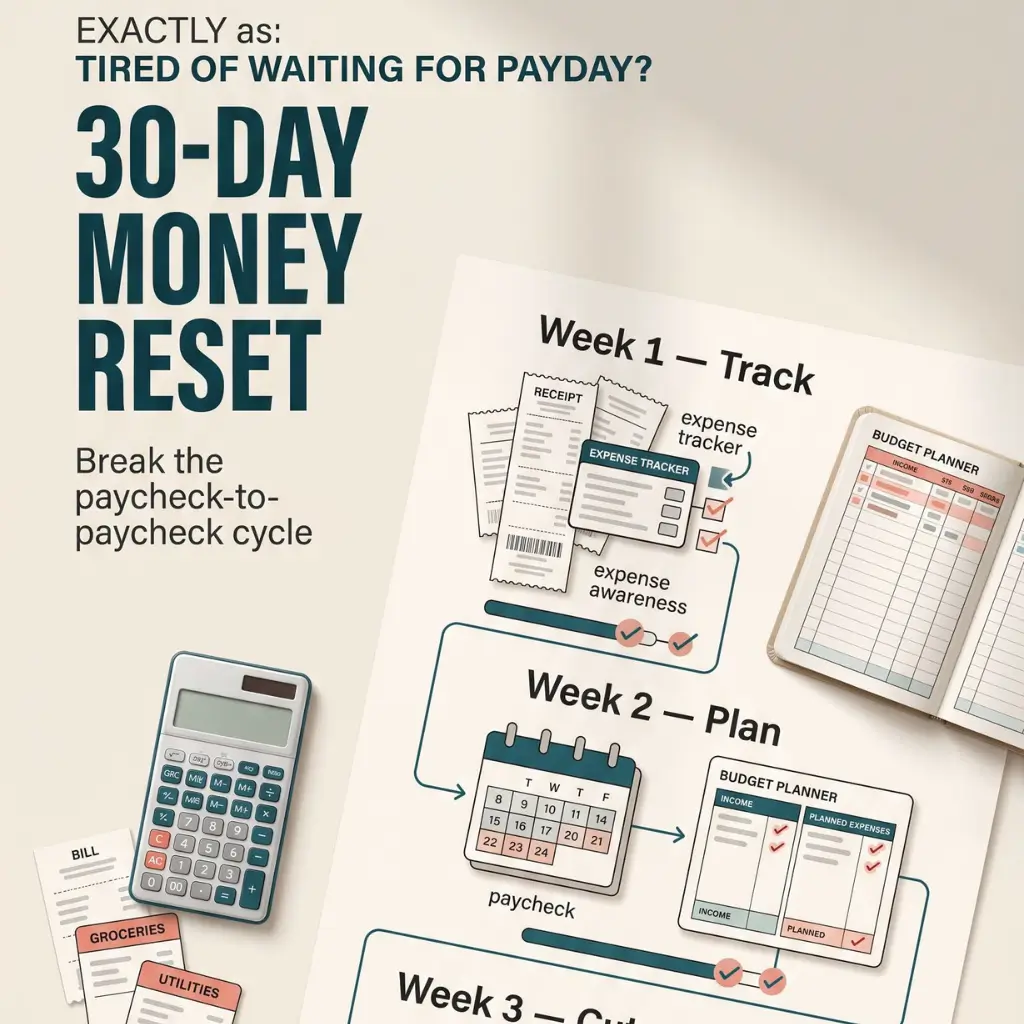

Learning how to stop living paycheck to paycheck does not begin with eliminating every nonessential purchase. It begins with understanding exactly where your money goes.
When nearly every paycheck is already committed, even a small unexpected expense can disrupt the entire month. A car repair, medical bill, or higher utility bill may force you to delay another payment or use credit.
A 30-day reset gives you a more manageable starting point.
During the next month, you will track your spending, organize bills, identify realistic reductions, and begin creating financial breathing room.
You do not need to transform your finances in 30 days. Instead, the goal is to finish the month with a clearer system and a small gap between what you earn and what you spend.
What Living Paycheck to Paycheck Actually Means
Living paycheck to paycheck generally means that most or all current income is needed before the next paycheck arrives.
For example, suppose your take-home income is $3,600 per month.
Your monthly spending might look like this:
| Expense | Monthly Amount |
|---|---|
| Housing | $1,350 |
| Utilities and phone | $350 |
| Transportation | $450 |
| Groceries | $600 |
| Debt payments | $400 |
| Insurance | $200 |
| Subscriptions and entertainment | $150 |
| Other spending | $100 |
| Total | $3,600 |
These amounts are hypothetical.
However, they illustrate the underlying problem clearly.
Income: $3,600
Expenses: $3,600
Money remaining: $0
The household does not necessarily have a spending problem in every category. Instead, it has no financial margin.
If a $250 unexpected expense appears, there is no existing $250 available to absorb it.
That is the cycle this 30-day reset aims to begin changing.
Before You Cut Anything, Find the Real Cause
The phrase “living paycheck to paycheck” describes a financial situation. It does not explain its cause.
That distinction matters.
Cutting restaurant spending will accomplish little if the real problem is an unaffordable housing payment. Likewise, earning more may not solve the problem if spending automatically increases with income.
Several different situations can create the same paycheck-to-paycheck cycle.
Your essential expenses may be too high
Housing, transportation, utilities, insurance, groceries, childcare, and required debt payments may consume most of your income.
In this situation, small lifestyle cuts can help. However, larger structural changes may eventually be necessary.
Small purchases may be accumulating
Individual purchases can look harmless.
A $12 purchase does not seem significant. Neither does another $18 purchase.
However, repeated discretionary transactions can consume substantial cash over an entire month.
This is why accurate expense tracking is important. You need actual numbers before deciding what should change.
Irregular expenses may keep surprising you
Some expenses are predictable but do not occur monthly.
Examples include:
- vehicle maintenance;
- annual subscriptions;
- school expenses;
- gifts;
- insurance premiums;
- home maintenance;
- seasonal expenses.
If these costs are never included in your monthly plan, they can feel like emergencies when they arrive.
Emotional or convenience spending may be involved
Spending can also become a response to boredom, stress, convenience, or habit.
That does not mean every discretionary purchase is a problem.
Instead, look for purchases that repeatedly conflict with your larger priorities.
If this is a major part of your situation, learning how to stop emotional spending can complement the numerical side of your reset.
Your income may simply be insufficient
Sometimes there is no meaningful amount left to optimize.
If basic living costs and minimum financial obligations already equal or exceed income, extreme budgeting will not solve the entire problem.
Your longer-term plan may need to include additional income, changes to major fixed costs, assistance programs where available, or a combination of these strategies.
Recognizing that reality is important because your 30-day plan should address your actual problem.
The 30-Day Paycheck-to-Paycheck Reset
This reset has four stages:
Days 1–7: Find out where your money is going.
Days 8–14: Build a workable spending plan.
Days 15–21: Create financial breathing room.
Days 22–30: Start building a buffer and prepare for the next month.
You can adjust the dates around your payday schedule.
The sequence matters more than the exact calendar day.
Days 1–7: Find Out Where Your Money Is Going
Do not begin the first week by aggressively cutting expenses.
Begin with information.
You need to know three numbers:
- how much money actually reaches your household;
- how much must leave for essential obligations;
- where the remainder is currently going.
Day 1: Calculate your actual take-home income
Use the amount that actually becomes available for spending.
If you receive $2,000 on one payday and $2,000 on another, your available monthly income is $4,000.
Do not build the budget around gross salary if that money never reaches your checking account.
For variable income, use a conservative amount when planning upcoming obligations.
Day 2: List every required bill
Write down your recurring obligations.
Include:
- rent or mortgage;
- utilities;
- insurance;
- phone;
- internet;
- childcare;
- minimum debt payments;
- transportation;
- required subscriptions or memberships.
Next to each bill, record its due date.
This turns an unorganized collection of payments into a calendar.
Day 3: Review recent transactions
Review recent bank and card transactions.
Do not estimate from memory.
Categorize your spending into useful groups.
For example:
Fixed obligations
- housing;
- insurance;
- loan payments.
Variable essentials
- groceries;
- fuel;
- utilities.
Flexible spending
- restaurants;
- entertainment;
- shopping.
Irregular expenses
- repairs;
- annual fees;
- gifts;
- medical costs.
You are trying to identify patterns, not judge individual transactions.
Day 4: Calculate your current monthly gap
Use a simple calculation:
Take-home income − total spending = monthly gap
Suppose your take-home income is $4,200.
If your total spending is $4,350:
$4,200 − $4,350 = −$150
You are running approximately $150 short.
If spending is $4,100:
$4,200 − $4,100 = $100
You technically have a $100 surplus.
However, that $100 may disappear unless you deliberately assign it a purpose.
A basic budget makes this relationship much easier to see. If you need the foundation first, use this step-by-step guide to budgeting before continuing.
Days 5–7: Track every purchase
For three days, record everything you spend.
Do not change your behavior dramatically simply because you are tracking it.
You need a realistic picture.
Record:
- amount;
- category;
- whether it was planned;
- whether it was essential;
- payment method.
At the end of Day 7, highlight recurring patterns.
Perhaps several small food purchases are accumulating. Maybe online shopping is higher than expected. Alternatively, you may discover that discretionary spending is already low.
Either finding is useful.
Days 8–14: Give Every Paycheck a Job
You now have enough information to build the next stage.
Your objective is not to create the world’s perfect budget.
Your objective is to prevent your available money from disappearing without a plan.
Day 8: Separate needs from flexible spending
Start with expenses that keep your household functioning.
Examples include:
- housing;
- basic food;
- utilities;
- essential transportation;
- insurance;
- required debt payments;
- necessary healthcare;
- childcare.
Then identify expenses with greater flexibility.
Examples might include:
- dining out;
- entertainment;
- nonessential shopping;
- optional subscriptions;
- convenience purchases.
The distinction will not be identical for every household.
Day 9: Create a minimum viable budget
A minimum viable budget covers the coming month without unnecessary complexity.
Start with:
Income
Then subtract:
Essential bills
Then:
Variable necessities
Then:
Minimum debt obligations
Then:
Savings or buffer contribution
Finally:
Flexible spending
If flexible spending is determined first, essential obligations can become difficult to cover later.
Day 10: Match bills to paychecks
This is especially useful when your monthly income is adequate but you still run short before payday.
Suppose you receive $2,000 twice per month.
Instead of treating the month as one large $4,000 pool, decide which obligations each paycheck must cover.
For example:
| Paycheck 1 | Amount |
|---|---|
| Income | $2,000 |
| Rent allocation | $1,000 |
| Groceries | $250 |
| Utilities | $200 |
| Transportation | $150 |
| Debt payment | $200 |
| Buffer | $100 |
| Flexible spending | $100 |
Then create a separate plan for Paycheck 2.
This method reduces the chance of spending money during the first half of the month that is needed during the second half.
Days 11–12: Choose a budgeting method you can maintain
There is no need to use a complicated system simply because it is popular.
Some readers prefer detailed zero-based budgeting. Others need broader spending categories.
The best system is one you can actually maintain.
You can compare several approaches in this guide to budgeting methods including zero-based and cash-flow budgeting.
For a 30-day reset, simplicity has an advantage.
You need enough structure to control cash flow without making the system exhausting.
Days 13–14: Add upcoming non-monthly expenses
Look beyond this month.
Ask:
What expenses are likely to arrive during the next 60 to 90 days?
For example:
- vehicle registration;
- school costs;
- annual membership;
- birthdays;
- insurance;
- holiday expenses;
- repairs.
Suppose you know a $300 expense is coming in three months.
Instead of waiting for a $300 bill:
$300 ÷ 3 = $100 per month
That converts a future surprise into a planned monthly expense.
Days 15–21: Create Your First Financial Breathing Room
By the third week, you understand your spending and have a working plan.
Now you need to create a gap between income and expenses.
Start with expenses that can be changed quickly.
Day 15: Review recurring expenses
Look for expenses that leave your account automatically.
Examples include:
- streaming subscriptions;
- memberships;
- software;
- premium app plans;
- storage plans;
- delivery memberships.
Do not automatically cancel everything.
Ask:
Would I deliberately buy this again today at its current price?
If the answer is no, consider removing or downgrading it.
Day 16: Review convenience spending
Convenience has value.
However, repeated convenience purchases can become expensive.
Review:
- food delivery;
- frequent takeout;
- convenience-store purchases;
- rushed grocery trips;
- premium delivery fees.
Instead of banning all convenience spending, reduce the least valuable purchases first.
Day 17: Review shopping habits
Look at nonessential purchases made during the previous month.
Identify which purchases were:
- planned;
- impulsive;
- replacements;
- convenience purchases;
- emotionally driven.
For optional purchases, try a waiting period before buying.
Even 24 or 48 hours can separate an immediate impulse from an actual priority.
Day 18: Look for larger recurring savings
Small cuts are useful. However, larger recurring expenses deserve attention too.
Review areas such as:
- phone service;
- internet;
- insurance;
- transportation costs;
- unused memberships.
You do not necessarily need to change providers.
The purpose is to determine whether you are still paying for services or features you value.
For additional opportunities, this guide to cutting unnecessary expenses can help you identify expenses worth reviewing.
Day 19: Set a realistic weekly spending limit
Take the money available for flexible spending and divide it into shorter periods.
Suppose you can realistically spend $400 per month on discretionary categories.
Instead of mentally managing the full $400, you might begin with approximately $100 per week for a four-week planning period.
The exact method depends on your calendar and pay schedule.
A weekly limit gives you faster feedback.
If most of the allowance disappears during the first two days, you can adjust before the entire month is affected.
Day 20: Redirect savings immediately
Suppose your expense review identifies:
- $25 subscription;
- $35 in reduced takeout;
- $20 unnecessary shopping;
- $30 service-plan reduction.
Total:
$25 + $35 + $20 + $30 = $110
Do not simply leave that $110 available for miscellaneous spending.
Give it a job.
Initially, that job might be your checking-account cushion or emergency savings.
Day 21: Review the first three weeks
Ask four questions:
- Which expenses surprised me?
- Which reductions were easy?
- Which reductions were unrealistic?
- How much financial margin have I created?
You are looking for sustainable improvements.
A $150 monthly reduction that you can maintain is more useful than an extreme $500 cut that lasts only several days.
Days 22–30: Build a Small Paycheck Buffer
Reducing spending is only part of the reset.
The next objective is to stop every unexpected cost from immediately threatening your next paycheck.
That requires cash reserves.
Day 22: Choose your first buffer target
Do not become discouraged by a large emergency-fund target.
Your first milestone can be smaller.
For example, you might initially aim for:
- $100;
- $250;
- $500;
- one common bill;
- another personally useful amount.
The right first target depends on your finances.
Your initial goal is simply to create separation between an unexpected expense and your next paycheck.
Days 23–24: Move your first contribution
Suppose your reset created $120 of breathing room.
You could transfer some or all of that amount into a separate savings account, depending on upcoming obligations.
The amount matters less than establishing the process.
Eventually, emergency savings can become a more formal part of your financial plan. This guide to emergency funds and simple financial foundations explains how that broader foundation fits together.
Day 25: Automate only an amount you can sustain
Automation can remove a repeated decision.
However, an automatic transfer should not cause overdrafts or leave essential bills unpaid.
Suppose you can reliably save $25 from each paycheck.
You could automate that amount after payday.
Two $25 transfers equal:
$25 × 2 = $50
That is not dramatic.
However, it turns saving into part of your normal cash-flow system.
You can increase the transfer later if your financial margin improves.
Day 26: Decide where the buffer will live
Emergency savings should generally remain accessible enough to handle an actual unexpected expense.
A separate savings account can also reduce the temptation to treat the money as ordinary checking-account cash.
If you later accumulate a larger emergency reserve, you may want to understand how high-yield savings accounts work.
Account rates and terms vary by institution, so compare current conditions before choosing an account.
Day 27: Create one rule for unexpected money
Decide in advance what you will do with unexpected or irregular income.
Examples might include:
- refunds;
- rebates;
- gifts;
- bonuses;
- overtime;
- side-income payments.
You do not have to save every dollar.
Instead, create a rule.
For example:
50% to your financial buffer, 30% to a planned goal, and 20% available for spending.
Those percentages are illustrative, not universal.
The important point is deciding before the money arrives.
Day 28: Prepare your next paycheck
Before your next paycheck arrives, write down exactly where it needs to go.
For example:
Next paycheck: $1,900
Housing: $800
Groceries: $250
Utilities: $180
Transportation: $150
Debt payment: $200
Savings buffer: $100
Flexible spending: $150
Upcoming expense: $70
Total: $1,900
The entire paycheck has a purpose before spending begins.
Day 29: Compare Day 1 with Day 29
Return to the numbers you calculated during the first week.
Suppose you began with:
Income: $3,800
Spending: $3,950
Gap: −$150
After reviewing expenses, suppose you reduce monthly spending to $3,700.
Your new position becomes:
$3,800 − $3,700 = $100
You have improved monthly cash flow by $250.
That does not mean your financial problems have disappeared.
However, you have changed the direction of your cash flow.
Instead of falling $150 behind, the hypothetical budget now has $100 available for building a buffer or another priority.
Day 30: Build the system for Month Two
Your 30-day reset ends with a plan for the next month.
Keep the parts that worked.
Change the parts that did not.
Your Month Two system might contain only five habits:
- Plan every paycheck before spending it.
- Track flexible expenses weekly.
- Review upcoming bills once per week.
- Transfer money to your buffer after payday.
- Complete a full budget review at month-end.
A simple system maintained for several months is more valuable than a complicated system abandoned after one week.
A Sample 30-Day Reset in Numbers
Consider a hypothetical household bringing home $4,000 per month.
Before the reset:
| Category | Before |
|---|---|
| Housing | $1,400 |
| Utilities/phone/internet | $400 |
| Groceries | $650 |
| Transportation | $400 |
| Debt payments | $450 |
| Insurance | $200 |
| Restaurants | $200 |
| Subscriptions | $100 |
| Shopping/other | $300 |
| Total | $4,100 |
Monthly cash flow:
$4,000 − $4,100 = −$100
The household is $100 short.
After reviewing expenses, suppose it makes these realistic changes:
- groceries: $650 → $600;
- restaurants: $200 → $125;
- subscriptions: $100 → $50;
- shopping/other: $300 → $225.
Savings created:
$50 + $75 + $50 + $75 = $250
New monthly spending:
$4,100 − $250 = $3,850
New monthly margin:
$4,000 − $3,850 = $150
The household moved from a $100 deficit to a $150 surplus.
That represents a $250 improvement in monthly cash flow.
The household could now decide how much of that $150 should remain as a checking cushion and how much should move into emergency savings.
Again, these figures are illustrative.
Your numbers may be very different.
What If You Cannot Find Enough Expenses to Cut?
This is an important possibility.
Some paycheck-to-paycheck advice assumes that everyone has hundreds of dollars of unnecessary spending.
That assumption is unrealistic.
You may track every dollar and discover that most of your income already pays for essentials.
In that situation, focus on three areas.
Review the largest expenses first
Saving $5 on a small subscription has limited value if a major recurring expense is creating the real deficit.
Consider whether any larger cost can realistically be renegotiated, reduced, refinanced where appropriate, shared, or changed over time.
Some changes may take months rather than days.
Look at income as well as expenses
If essential expenses are already lean, improving income may have greater potential than additional cuts.
Depending on your situation, options could include:
- additional work hours;
- overtime;
- freelance work;
- temporary side work;
- selling unused items;
- applying for better-paying positions;
- developing a marketable skill.
These options are not equally accessible to everyone.
Therefore, treat them as possibilities rather than requirements.
Do not sacrifice essential financial protections
A reset should not encourage you to skip necessary medications, essential insurance, required debt payments, basic food, utilities, or other critical needs simply to report a lower spending number.
The objective is sustainable financial improvement.
Extreme deprivation is not a budgeting system.
Why a Small Buffer Changes the Paycheck Cycle
Imagine you normally have $20 remaining before payday.
Then a $150 car expense appears.
You are $130 short.
Now imagine that several months of gradual saving have created a $500 buffer.
The same $150 expense is still inconvenient.
However, it does not automatically require borrowing from the next paycheck.
That difference is fundamental.
Breaking the paycheck-to-paycheck cycle is not only about spending less.
It is about gradually creating enough financial margin to absorb normal irregularities.
The process often looks like this:
Track spending → create a budget → improve cash flow → build a buffer → prepare for irregular expenses → increase financial stability
You do not need to complete the entire progression during your first 30 days.
You need to begin moving through it.
Common Mistakes During a 30-Day Financial Reset
Trying to change everything immediately
If you simultaneously eliminate every discretionary purchase, adopt a complicated budgeting system, open several accounts, start multiple savings goals, and completely reorganize your finances, the reset can become difficult to maintain.
Choose a few high-impact actions first.
Setting an unrealistic savings target
Your first buffer does not need to equal several months of expenses.
A smaller milestone can create immediate practical value.
Build from there.
Forgetting irregular expenses
A budget may appear successful until an annual bill arrives.
Review upcoming expenses regularly.
Cutting small pleasures while ignoring major costs
Small purchases are visible, so they receive considerable attention.
However, large recurring expenses may offer greater long-term opportunities.
Review both.
Treating one bad spending day as failure
A 30-day reset is a planning process, not a perfection challenge.
If you overspend on Day 12, update the remaining plan.
Do not abandon Days 13 through 30.
Saving while leaving your checking account dangerously low
Moving money to savings should not force you to borrow for basic bills several days later.
Build your buffer at a sustainable pace.
Frequently Asked Questions
Can you really stop living paycheck to paycheck in 30 days?
Not necessarily.
The 30-day reset is designed to change your financial system and direction.
A household with a modest spending imbalance might create breathing room quickly. Another household facing high essential expenses, debt, or insufficient income may need considerably longer.
The realistic objective is progress, not a guaranteed 30-day transformation.
How much money should I save during the reset?
There is no universal amount.
First cover essential obligations. Then determine what amount can realistically become a buffer without creating another shortage.
Even a modest first contribution establishes the process.
Should I pay off debt or build savings first?
The appropriate balance depends on factors such as required payments, interest costs, available savings, financial stability, and the risk of unexpected expenses.
For a reader with no cash reserve, even a modest buffer can help prevent every surprise expense from immediately returning to credit.
More complex debt decisions may require individualized analysis.
What should I cut first when living paycheck to paycheck?
Start with spending that provides relatively little value and can be changed without threatening essential needs.
Unused subscriptions, recurring fees, frequent convenience purchases, and low-priority discretionary spending are common places to review.
Then examine larger recurring expenses.
Should my emergency fund be in a separate account?
A separate account can make the money easier to distinguish from everyday spending.
However, accessibility, fees, minimum balances, withdrawal conditions, and other account terms matter.
Compare the current terms of any account before using it.
What if I have irregular income?
Base required commitments on a conservative income estimate when possible.
During stronger income periods, part of the additional money can help create a buffer for lower-income periods.
You may also need a larger cash-flow cushion than someone receiving the same predictable paycheck every month.
Your Next 30 Days Matter More Than a Perfect Budget
Learning how to stop living paycheck to paycheck is ultimately about creating margin.
During your first 30 days, concentrate on understanding your numbers rather than chasing an unrealistic transformation.
Track what you spend. Organize bills around your paychecks. Reduce expenses that provide little value. Prepare for predictable non-monthly costs. Then direct whatever margin you create toward a small financial buffer.
Your first result might be $50, $100, or $250 of breathing room.
The amount will depend on your circumstances.
What matters is changing the pattern from:
paycheck → spending → $0 → next paycheck
toward:
paycheck → planned spending → buffer → next paycheck
Once that margin exists, you have something to build on.