
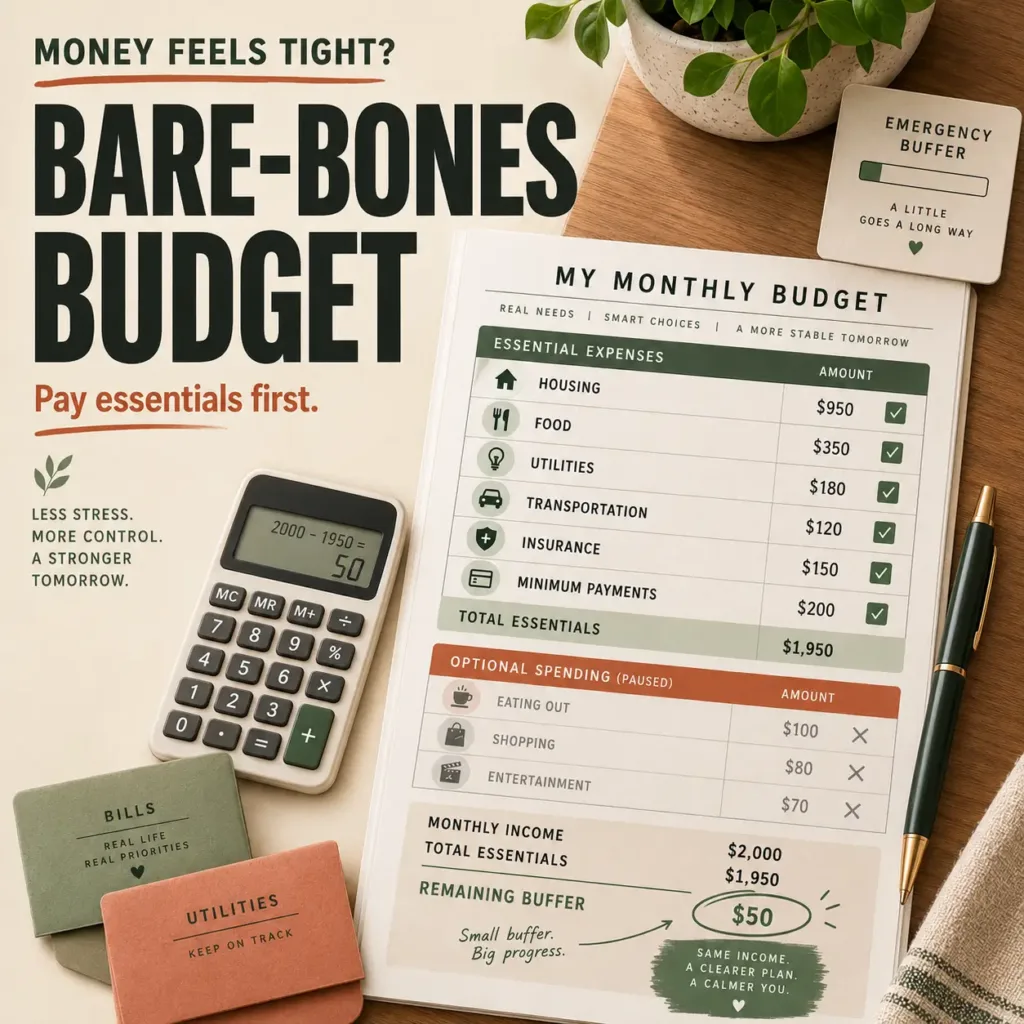

Learning how to budget when money is tight is different from ordinary budgeting. You are not trying to optimize every financial goal at once. Instead, you are deciding which expenses must be protected, which can be reduced, and which can temporarily disappear.
That distinction matters.
When income barely covers your monthly expenses, a complicated budget can become another source of stress. A bare-bones budget simplifies the problem. It focuses your available money on housing, food, essential utilities, transportation, insurance, minimum required payments, and other true necessities.
Everything else becomes negotiable.
A bare-bones budget is not meant to be permanent. Instead, it is a temporary financial survival plan. You might use one after losing income, facing unexpected expenses, paying down urgent debt, or simply realizing that your current spending is no longer sustainable.
The goal is straightforward: keep your essential financial life running while creating as much breathing room as possible.
Here is how to build a bare-bones budget that actually works.
What Is a Bare-Bones Budget?
A bare-bones budget is a stripped-down version of your normal monthly budget.
It includes expenses that are necessary to maintain your basic needs and financial obligations. Meanwhile, discretionary expenses are reduced or temporarily removed.
For example, your regular budget might contain:
- Housing
- Groceries
- Utilities
- Transportation
- Insurance
- Debt payments
- Savings
- Streaming subscriptions
- Restaurant meals
- Clothing
- Entertainment
- Travel
- Hobbies
- Convenience purchases
A bare-bones version might contain only:
- Housing
- Basic utilities
- Essential groceries
- Transportation required for work
- Insurance
- Medication and necessary healthcare
- Minimum required debt payments
- A small emergency cushion, when possible
Therefore, the purpose is not extreme deprivation.
The purpose is prioritization.
The Consumer Financial Protection Bureau provides resources specifically for situations where people must prioritize bills and spending when cash is limited. It also recommends reviewing available income before deciding how bills and debts will be paid.
When Should You Use a Bare-Bones Budget?
You do not need to wait for a financial emergency.
A bare-bones budget can be useful whenever your financial margin becomes dangerously small.
For example, consider using one when:
- Your income has dropped.
- Your hours at work were reduced.
- You are between jobs.
- Your expenses suddenly increased.
- You are recovering from an emergency.
- You regularly run out of money before payday.
- Your credit card balances keep increasing.
- You need to stop relying on savings for ordinary expenses.
- You are preparing for a temporary period of lower income.
- You need several months to stabilize your finances.
You can also use a bare-bones budget as a financial exercise.
Even when finances are stable, calculating your minimum monthly cost of living reveals valuable information.
Suppose your normal spending equals $4,000 monthly. However, your essential expenses equal only $2,650.
You now know that your approximate financial survival number is $2,650.
That figure can help you plan emergency savings, evaluate job changes, and understand how much flexibility exists inside your normal budget.
If you have never created a complete spending plan, start with this guide to mastering the basics of budgeting.
Step 1: Calculate Your Actual Take-Home Income
Start with money you can actually spend.
Do not build your budget around gross salary.
Instead, calculate your dependable monthly take-home income after taxes, payroll deductions, insurance premiums, and other deductions.
Include income such as:
- Regular wages
- Reliable freelance income
- Benefits
- Pension income
- Child support actually received
- Other dependable recurring income
Be cautious with irregular income.
For example, suppose your freelance income during the previous four months was:
Month 1: $900
Month 2: $1,500
Month 3: $700
Month 4: $1,300
The average is $1,100.
However, budgeting around $1,100 may still be risky because your lowest month was only $700.
When money is already tight, conservative estimates are safer.
You might build your essential budget around $700 to $900 and treat additional income as money for upcoming bills, savings, or other priorities.
Do Not Count Money Before You Receive It
Expected bonuses, overtime, tax refunds, gifts, commissions, and side-income opportunities should not automatically fund essential bills.
Instead, build your basic plan around income you can reasonably expect.
This creates a more resilient budget.
Step 2: Track Where Your Money Is Going
Before cutting anything, determine what you currently spend.
Many people know their rent or mortgage payment. However, they underestimate groceries, delivery fees, subscriptions, convenience purchases, small shopping transactions, and miscellaneous spending.
Review at least one full month of transactions.
Two or three months is even better.
Check:
- Bank statements
- Credit card statements
- Payment applications
- Automatic payments
- Cash spending
- Subscription renewals
Then divide transactions into categories.
Do not judge the numbers yet.
Your first objective is accuracy.
For a detailed process, see our guide to mastering expense tracking.
Tracking matters because cutting a budget without knowing where money actually goes often produces unrealistic targets.
For example, you might assume groceries cost $500 monthly.
After reviewing transactions, you discover:
Groceries: $610
Takeout: $180
Coffee and snacks: $95
Food-related spending is actually $885.
That gives you substantially more information for making decisions.
Step 3: Separate Needs From Wants
This is the core of a bare-bones budget.
Every expense should go into one of three groups:
Essential
The expense protects your housing, health, ability to work, basic nutrition, or important financial obligations.
Reducible
The expense may be necessary, but its cost can potentially be lowered.
Temporary pause
The expense can be eliminated during your bare-bones period without creating serious consequences.
Consider this example.
| Expense | Normal Cost | Bare-Bones Decision |
|---|---|---|
| Rent | $1,300 | Keep |
| Electricity | $120 | Keep |
| Internet | $80 | Keep if needed |
| Groceries | $650 | Reduce |
| Car insurance | $140 | Keep |
| Gas | $180 | Reduce if possible |
| Streaming | $45 | Pause |
| Restaurants | $250 | Pause |
| Gym | $50 | Review |
| Shopping | $200 | Pause |
Notice that necessities are not always fixed.
Groceries are essential. However, the amount spent on groceries can often change.
Transportation may be essential. However, unnecessary driving may not be.
Internet access may be essential for remote work, education, or job searching. However, a premium package may not be essential.
This distinction prevents bare-bones budgeting from becoming an arbitrary exercise in cutting everything.
Step 4: Protect Your Four Financial Priorities
When there is not enough money for every goal, your budget needs a hierarchy.
A useful starting framework is:
1. Housing
Protect the expense that keeps you safely housed.
This can include:
- Rent
- Mortgage
- Essential property charges
- Required housing insurance
2. Essential Food and Healthcare
Your budget needs enough money for reasonable nutrition and necessary medical care.
This category can include:
- Basic groceries
- Necessary prescriptions
- Medical supplies
- Required healthcare expenses
3. Utilities and Transportation
Protect services required for daily living and earning income.
Depending on your circumstances, these could include:
- Electricity
- Water
- Heating
- Basic phone service
- Internet
- Fuel
- Public transportation
- Necessary vehicle costs
4. Critical Financial Obligations
Finally, account for required insurance and important payment obligations.
However, priorities depend on individual circumstances.
If you cannot pay every bill, do not simply pay whichever creditor contacts you first. Instead, examine the consequences of missing each payment.
The CFPB specifically provides a bill-prioritization framework for consumers dealing with limited cash.
If you believe you will miss a required payment, contacting the creditor or service provider before the due date may also reveal available payment arrangements. The CFPB recommends being proactive when borrowers cannot make certain bill or debt payments.
Step 5: Cut the Expenses That Do Not Protect Your Basic Needs
Now examine your discretionary spending.
Common temporary cuts include:
- Restaurant meals
- Food delivery
- Premium streaming subscriptions
- Unnecessary subscriptions
- Entertainment purchases
- Impulse shopping
- Decorative home purchases
- Nonessential clothing
- Convenience fees
- Paid apps
- Frequent coffee purchases
- Hobby spending
- Travel
- Upgrades and premium services
However, avoid chasing tiny savings while ignoring large recurring expenses.
Saving $8 on coffee will not solve a $600 monthly budget deficit.
Therefore, look at your largest flexible expenses first.
If you need more ideas, review our guide to cutting unnecessary expenses.
You can also use these 10 proven steps to eliminate wasted expenses to identify spending that provides little value.
Step 6: Reduce Necessary Expenses Instead of Eliminating Them
Some categories cannot disappear.
Nevertheless, their cost may be adjustable.
Groceries
Rather than setting an unrealistically small grocery budget, focus on reducing waste.
Consider:
- Planning meals before shopping
- Comparing unit prices
- Using ingredients already at home
- Buying fewer convenience foods
- Reducing food waste
- Shopping with a list
- Preparing inexpensive repeat meals
The goal is sustainability.
A grocery budget that lasts only one week before requiring extra spending is not useful.
Transportation
If possible, combine errands and reduce unnecessary trips.
You might also compare insurance rates periodically. However, avoid reducing important insurance protection solely to lower a premium without understanding the consequences.
Phone and Internet
Review your actual usage.
You may discover that a lower-cost plan meets your needs.
Utilities
Small behavioral adjustments can reduce some utility costs.
However, do not compromise health or safety to achieve minor savings.
Step 7: Build Your Bare-Bones Budget
Now combine your essential categories.
Suppose monthly take-home income equals $3,200.
Your essential expenses might look like this:
| Category | Amount |
|---|---|
| Rent | $1,250 |
| Utilities | $180 |
| Groceries | $450 |
| Transportation | $300 |
| Insurance | $220 |
| Phone and Internet | $120 |
| Healthcare | $100 |
| Minimum debt payments | $300 |
| Small emergency contribution | $100 |
| Essential household spending | $80 |
| Total | $3,100 |
Income: $3,200
Bare-bones expenses: $3,100
Remaining margin: $100
That is a tight budget.
Nevertheless, it is balanced.
The $100 should not automatically become spending money. When finances are fragile, it can provide protection against small fluctuations.
For example, a higher utility bill or necessary prescription could otherwise push the month onto a credit card.
What If Your Bare-Bones Expenses Are Higher Than Your Income?
This is the most important calculation in the entire process.
Suppose your monthly income equals $2,800.
Your bare-bones expenses equal $3,150.
You have a $350 monthly deficit.
At this point, canceling another $10 subscription is not enough.
Your problem is structural.
You now have four broad possibilities:
Reduce essential expenses further.
Look for meaningful reductions in housing, transportation, insurance, utilities, groceries, and other large categories where realistically possible.
Increase income.
Additional hours, temporary work, freelance work, selling unused items, or another income source may help close the gap.
Renegotiate obligations.
Depending on the bill and your situation, a provider or creditor may offer different payment arrangements.
Use available assistance appropriately.
If income does not cover basic necessities, investigate legitimate local or government assistance programs for which you may qualify.
The CFPB advises consumers who cannot meet certain credit or bill payments to contact the company and ask about more affordable repayment options.
The key point is simple:
A mathematical deficit cannot be solved by motivation alone.
If essential expenses consistently exceed income, the numbers themselves must change.
Step 8: Keep a Small Emergency Buffer If You Can
It may seem strange to save while money is tight.
However, having absolutely no cash reserve can make your budget more fragile.
A flat tire, prescription, school expense, or small repair can force you to borrow.
Therefore, even a modest buffer can have practical value.
The CFPB describes an emergency fund as cash reserved for unplanned expenses such as repairs, medical bills, or income loss. It also notes that even small amounts can provide some financial security.
Do not assume you must immediately save several months of expenses.
When your budget is extremely tight, begin with what your cash flow realistically permits.
That could be:
$5 per week.
$10 per paycheck.
$25 per month.
The initial goal is simply to create separation between a small emergency and new debt.
For a broader strategy, read Financial Foundations: Emergency Funds and Simple Plans.
Step 9: Create a Weekly Spending Number
Monthly budgets can feel abstract.
Therefore, convert flexible categories into weekly limits.
Suppose your monthly bare-bones plan includes:
Groceries: $480
Fuel: $160
Household expenses: $80
Total flexible essentials: $720.
A simple four-week planning approach gives:
$720 ÷ 4 = $180 per week.
You could then use approximately $180 as a weekly spending target for those categories.
You do not have to spend exactly $180 every week.
Instead, the number works as an early-warning system.
If you spend $280 during the first week, you know immediately that the rest of the month requires adjustment.
Without a weekly checkpoint, you might discover the problem only after your account becomes dangerously low.
Step 10: Check Your Budget Before Every Payday
A bare-bones budget works better when you actively manage it.
Before each payday, review:
- Current checking balance
- Upcoming income
- Bills due before the next paycheck
- Grocery needs
- Transportation needs
- Automatic payments
- Unexpected expenses
- Available emergency savings
Then assign the incoming money intentionally.
For example:
Paycheck: $1,600
Rent allocation: $650
Groceries: $225
Utilities: $120
Transportation: $150
Insurance: $110
Debt payment: $150
Other necessities: $95
Emergency buffer: $50
Amount left unassigned: $50
This approach reduces the risk of spending available cash before remembering that it already has another purpose.
Expenses You Should Be Careful About Cutting
Bare-bones budgeting should not mean automatically eliminating anything that costs money.
Be especially cautious around:
Insurance
Canceling important insurance can expose you to losses far larger than the premium you save.
Healthcare
Delaying necessary treatment or medication can create serious consequences.
Transportation required for income
Saving money by making it harder to reach work can be counterproductive.
Basic nutrition
An extremely restrictive food budget that cannot realistically feed your household will fail.
Small expenses that protect your ability to earn
For example, internet service may appear discretionary. However, it may be essential if you work remotely.
The correct question is not:
“Can I eliminate this?”
Instead, ask:
“What happens if I eliminate this?”
That question produces better financial decisions.
How Long Should You Stay on a Bare-Bones Budget?
There is no universal timeline.
You might use one for:
- One difficult month
- A 30-day financial reset
- Three months after an income reduction
- Several months while rebuilding savings
- A temporary debt-repayment period
However, extreme restriction is difficult to maintain indefinitely.
Therefore, define an exit condition.
For example:
“I will follow my bare-bones budget until I save a $1,000 starter emergency fund.”
Or:
“I will use this budget until my new income becomes stable for three months.”
Or:
“I will stay on this plan until my monthly cash flow is consistently positive.”
An exit condition turns your bare-bones budget into a temporary strategy rather than an undefined financial lifestyle.
Bare-Bones Budget Template
You can create your own plan using this simple structure.
Monthly Income
Take-home pay: ______
Other dependable income: ______
Total income: ______
Essential Housing
Rent or mortgage: ______
Required housing expenses: ______
Essential Utilities
Electricity: ______
Water: ______
Heating: ______
Phone: ______
Internet: ______
Food
Groceries: ______
Transportation
Fuel: ______
Public transportation: ______
Essential vehicle expenses: ______
Health and Insurance
Insurance: ______
Medication: ______
Necessary medical expenses: ______
Financial Obligations
Required debt payments: ______
Other essential obligations: ______
Emergency Buffer
Small emergency contribution: ______
Final Calculation
Total monthly income: ______
Total bare-bones expenses: ______
Monthly margin: ______
If the result is positive, decide where the remaining money provides the greatest protection.
If the result is zero, your budget has no room for unexpected costs.
If the result is negative, additional changes are necessary.
A Bare-Bones Budget Is About Control, Not Perfection
Knowing how to budget when money is tight does not mean finding a magical way to make every financial problem disappear.
Instead, it means making deliberate decisions with the money currently available.
Start with your real take-home income.
Then track your actual spending.
Protect housing, basic food, healthcare, essential utilities, transportation, insurance, and critical obligations.
Reduce everything that can reasonably be reduced.
Pause expenses that can wait.
Finally, preserve a small emergency cushion whenever your circumstances allow it.
Your first bare-bones budget may not balance perfectly.
That information is still valuable.
If your essential expenses exceed your income, you have identified the size of the problem. You can then focus on the changes that matter most instead of repeatedly making small cuts that never close the gap.
A bare-bones budget is not about spending as little as humanly possible.
It is about knowing exactly what your money needs to accomplish first.